AI Essay Tester

AI Essay Tester — independent reviews, comparisons, pricing and step-by-step guides on Aizhi.

  • Common Image Generator Interface

    Common Image Generator Interface

    The Common Image Generator Interface (CIGI) (pronounced sig-ee), is an on-the-wire data protocol that allows communication between an Image Generator and its host simulation. The interface is designed to promote a standard way for a host device to communicate with an image generator (IG) within the industry. CIGI enables plug-and-play by standard-compliant image generator vendors and reduces integration costs when upgrading visual systems. == Background == Most high-end simulators do not have everything running on a single machine the way popular home software flight simulators are currently implemented. The airplane model is run on one machine, normally referred to as the host, and the out the window visuals or scene graph program is run on another, usually referred to as an Image Generator (IG). Frequently there are multiple IGs required to display the surrounding environment created by a host. CIGI is the interface between the 'host' and the IGs. The main goal of CIGI is to capitalize on previous investments through the use of a common interface. CIGI is designed to assist suppliers and integrators of IG systems with ease of integration, code reuse, and overall cost reduction. In the past most image generators provided their own proprietary interface; every host had to implement that interface making changing image generators a costly ordeal. CIGI was created to standardize the interface between the host and the image generator so that little modification would be needed to switch image generators. The CIGI initiative was largely spearheaded by The Boeing Company during the early 21st century. The latest version of CIGI (CIGI 4.0) was developed by the Simulation Interoperability Standards Organization (SISO) in the form of SISO-STD-013-2014, Standard for Common Image Generator Interface (CIGI), Version 4.0, dated 22 August 2014. SISO-STD-013-2014 is freely available from SISO. == Definitions == Image generator – In this context an image generator consists of one or more rendering channels that produce an image that can be used to visualize an “Out-The-Window” scene, or images produced by various sensor simulations such as Infra-red, Day TV, electro-optical, and night vision. Host simulation – In this context a “Host” is the computational system that provides information about the device being simulated so that the image generator can portray the correct scenery to the user. This information is passed via CIGI to the image generator. == Maturation == CIGI 4 is the latest version of the standard as was approved by the Simulation Interoperability Standards Organization on August 22, 2014. CIGI became an international SISO standard known as SISO-STD-013-2014; which contains the CIGI version 4.0 Interface Control Document (ICD). CIGI 4.0 is the official standard, published by SISO. Previous versions of CIGI were spearheaded by Boeing include CIGI v3.3, in November 2008, v3.2 April 2006, v3.1 June 2004, v3 November 2003, v2 in March 2002, and the original (v1) in March 2001 == Protocol dependencies == Typically, CIGI uses UDP as its transport protocol, but CIGI does not require a specific transport mechanism, only packet definition conformance. CIGI traffic does not have a well known port; however, the use of ports 8004-8005 has been widely adopted by commercial image generator vendors implementations. == Development tools == === Host Emulator === The Host Emulator can be used as a surrogate to manipulate the interface when a simulation Host is not available. It is a Windows-based image generator Host application used to develop, integrate and test image generators that use the CIGI protocol. It provides a graphical user interface (GUI) for the creation, modification and deletion of entities; manipulation of views; control of environmental attributes and phenomena; and other host functions. The Host Emulator has several features that are useful for integration and testing. A free-flight mode allows for fixed-wing and rotorcraft flight, movement along entity axes and free rotation using a joystick or a joystick-like widget. Scripting and record/playback features support regression testing, demonstrations and other tasks needing exact reproduction of certain sequences of events. A packet-level snoop feature allows the user to examine the contents of CIGI messages, image generator response times and latencies. A Heartbeat Monitor Window shows a graphical timing history of the Image Generator's data frame rate. Other features include explicit packet creation, animation control, missile flyouts and a situation display window (Host Emulator 3.x only). === Multi-Purpose Viewer === The Multi-Purpose Viewer (MPV) provides the basic functionality expected of an Image Generator, such as loading and displaying a terrain database, displaying entities and so forth. The Multi-Purpose Viewer can be used as a surrogate to manipulate the interface when a real Image Generator is not available. The MPV is capable of operating with both the Windows and Linux operating systems. === CIGI Class Library === The CCL is an object-oriented software interface that automatically handles message composition and decomposition (i.e. packing, unpacking and byte swapping to the ICD specification) on both the Host and Image Generator sides of the interface. The CCL interprets Host or Image Generator messages based on compile time parameters. It also performs error handling and translation between different versions of CIGI. Each packet type has its own class. The individual packet members are accessed through packet class accessors. Outgoing messages are constructed by placing each packet into the outgoing buffer using a streaming operator. Incoming messages are parsed using callback or event-based mechanisms that supply the using program with fully populated packet objects. === Current tool suite === A set of CIGI development tools are managed and maintained by the SISO CIGI Product Support Group. The latest packages are available on SourceForge. Comments/Suggestions to the package can be directed to the SISO discussion board at: https://discussions.sisostds.org/index.htm?A0=SAC-PSG-CIGI Archived 2017-09-13 at the Wayback Machine === Wireshark === Wireshark is a free and open source packet analyzer. It is used for network troubleshooting, analysis, software and communications protocol development, and education. Wireshark provides a dissector for CIGI packets. As of October 2016, “The CIGI dissector is fully functional for CIGI version 2 and 3. Version 1 is not yet implemented.” === Older versions of CIGI === A CIGI Interface Control Document (ICD) and development suite is available in open source format. The tools, ICD, and accompanying user documentation can be found and downloaded from the CIGI sourceforge web site. The SourceForge version of the MPV is limited in its support of CIGI data packets and is intended to grow as needs arise. The MPV uses CIGI 3 as its interface, but the MPV is backward-compatible with earlier CIGI versions through the use of the CCL. The MPV uses the Open Scene Graph library to render a scene. The scene graph is manipulated according to the CIGI commands received from the Host via the CCL. The MPV itself is an application layer that consists of a small kernel leveraging heavily on a plug-in architecture for ease of maintainability and flexibility. An implementer can implement the interface from scratch, however a full suite of integration tools is available. These tools consist of three elements. The Host Emulator (HE), the Multi-Purpose Viewer (MPV), and the CIGI Class Library (CCL).

    Read more →
  • Anthrobotics

    Anthrobotics

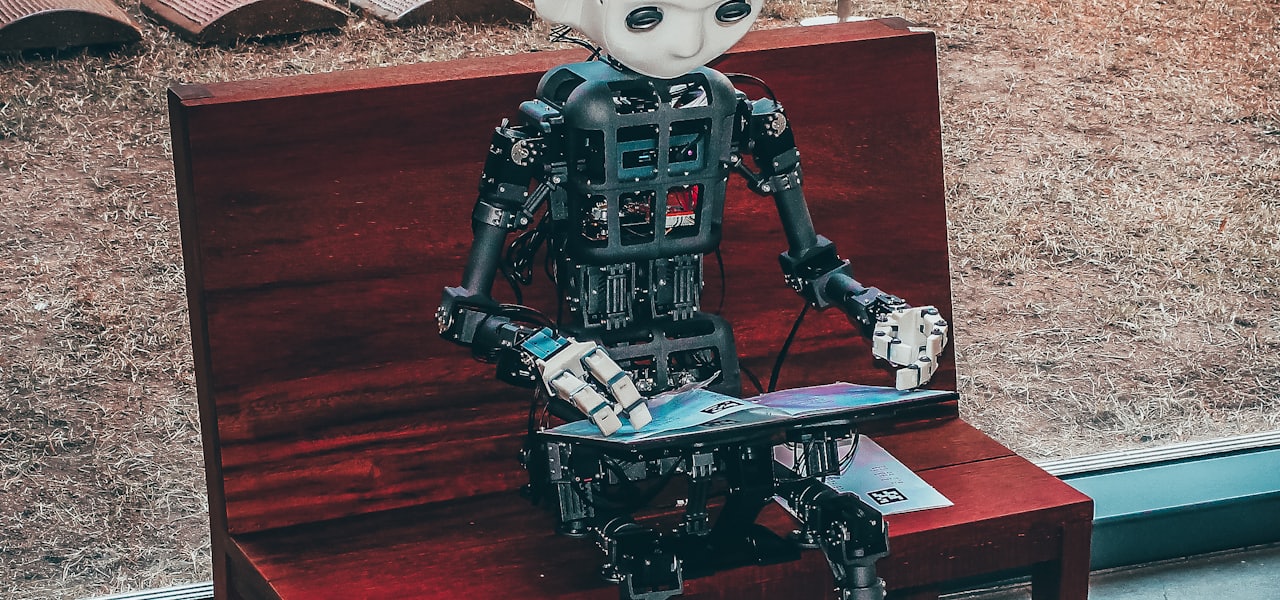
    Anthrobotics is the science of developing and studying robots that are either entirely or in some way human-like. The term anthrobotics was originally coined by Mark Rosheim in a paper entitled "Design of An Omnidirectional Arm" presented at the IEEE International Conference on Robotics and Automation, May 13–18, 1990, pp. 2162–2167. Rosheim says he derived the term from "...Anthropomorphic and Robotics to distinguish the new generation of dexterous robots from its simple industrial robot forebears." The word gained wider recognition as a result of its use in the title of Rosheim's subsequent book Robot Evolution: The Development of Anthrobotics, which focussed on facsimiles of human physical and psychological skills and attributes. However, a wider definition of the term anthrobotics has been proposed, in which the meaning is derived from anthropology rather than anthropomorphic. This usage includes robots that respond to input in a human-like fashion, rather than simply mimicking human actions, thus theoretically being able to respond more flexibly or to adapt to unforeseen circumstances. This expanded definition also encompasses robots that are situated in social environments with the ability to respond to those environments appropriately, such as insect robots, robotic pets, and the like. Anthrobotics is now taught at some universities, encouraging students not only to design and build robots for environments beyond current industrial applications, but also to speculate on the future of robotics that are embedded in the world at large, as mobile phones and computers are today. In 2016 philosopher Luis de Miranda created the Anthrobotics Cluster at the University of Edinburgh "a platform of cross-disciplinary research that seeks to investigate some of the biggest questions that will need to be answered" on the relationship between humans, robots and intelligent systems and "a think tank on the social spread of robotics, and also how automation is part of the definition of what humans have always been". to explore the symbiotic relationship between humans and automated protocols.

    Read more →
  • Aldus PhotoStyler

    Aldus PhotoStyler

    Aldus PhotoStyler was a graphics software program developed by the Taiwanese company Ulead. Released in June 1991 as the first 24 bit image editor for Windows, it was bought the same year by the Aldus Prepress group. Its main competition was Adobe Photoshop. Version 2.0 (late 1993) introduced a new user interface and improved color calibration. PhotoStyler SE - lacking some features of the version 2.0 - was bundled with scanners like HP ScanJet. The product disappeared from the Adobe product line after Adobe acquired Aldus in 1994.

    Read more →
  • Shepp–Logan phantom

    Shepp–Logan phantom

    The Shepp–Logan phantom is a standard test image created by Larry Shepp and Benjamin F. Logan for their 1974 paper "The Fourier Reconstruction of a Head Section". It serves as the model of a human head in the development and testing of image reconstruction algorithms. == Definition == The function describing the phantom is defined as the sum of 10 ellipses inside a 2×2 square:

    Read more →
  • AIX Toolbox for Linux Applications

    AIX Toolbox for Linux Applications

    The AIX Toolbox for Linux Applications is a collection of GNU tools for IBM AIX. These tools are available for installation using Red Hat's RPM format. == Licensing == Each of these packages includes its own licensing information and while IBM has made the code available to AIX users, the code is provided as is and has not been thoroughly tested. The Toolbox is meant to provide a core set of some of the most common development tools and libraries along with the more popular GNU packages.

    Read more →
  • Google Tasks

    Google Tasks

    Google Tasks is a task management application developed by Google and included with Google Workspace. Included initially as a feature in Gmail and Google Calendar, Google Tasks launched as a core product with a standalone app in 2018. It is available for Android and iOS, as well as in the right-hand side panel on Google Workspace apps on the web and in Google Calendar. == History and development == Google Tasks began as an integration within other apps in G Suite (now Google Workspace), allowing to-do items to be created in Calendar and Gmail. Upon graduating to a core service on June 28, 2018, Google Tasks launched as a dedicated mobile app in which tasks can be sorted into lists, managed, and completed. Google Tasks launched the ability to create tasks from Google Chat messages in 2022.

    Read more →
  • Shape analysis (digital geometry)

    Shape analysis (digital geometry)

    This article describes shape analysis to analyze and process geometric shapes. == Description == Shape analysis is the (mostly) automatic analysis of geometric shapes, for example using a computer to detect similarly shaped objects in a database or parts that fit together. For a computer to automatically analyze and process geometric shapes, the objects have to be represented in a digital form. Most commonly a boundary representation is used to describe the object with its boundary (usually the outer shell, see also 3D model). However, other volume based representations (e.g. constructive solid geometry) or point based representations (point clouds) can be used to represent shape. Once the objects are given, either by modeling (computer-aided design), by scanning (3D scanner) or by extracting shape from 2D or 3D images, they have to be simplified before a comparison can be achieved. The simplified representation is often called a shape descriptor (or fingerprint, signature). These simplified representations try to carry most of the important information, while being easier to handle, to store and to compare than the shapes directly. A complete shape descriptor is a representation that can be used to completely reconstruct the original object (for example the medial axis transform). == Application fields == Shape analysis is used in many application fields: archeology for example, to find similar objects or missing parts architecture for example, to identify objects that spatially fit into a specific space medical imaging to understand shape changes related to illness or aid surgical planning virtual environments or on the 3D model market to identify objects for copyright purposes security applications such as face recognition entertainment industry (movies, games) to construct and process geometric models or animations computer-aided design and computer-aided manufacturing to process and to compare designs of mechanical parts or design objects. == Shape descriptors == Shape descriptors can be classified by their invariance with respect to the transformations allowed in the associated shape definition. Many descriptors are invariant with respect to congruency, meaning that congruent shapes (shapes that could be translated, rotated and mirrored) will have the same descriptor (for example moment or spherical harmonic based descriptors or Procrustes analysis operating on point clouds). Another class of shape descriptors (called intrinsic shape descriptors) is invariant with respect to isometry. These descriptors do not change with different isometric embeddings of the shape. Their advantage is that they can be applied nicely to deformable objects (e.g. a person in different body postures) as these deformations do not involve much stretching but are in fact near-isometric. Such descriptors are commonly based on geodesic distances measures along the surface of an object or on other isometry invariant characteristics such as the Laplace–Beltrami spectrum (see also spectral shape analysis). There are other shape descriptors, such as graph-based descriptors like the medial axis or the Reeb graph that capture geometric and/or topological information and simplify the shape representation but can not be as easily compared as descriptors that represent shape as a vector of numbers. From this discussion it becomes clear, that different shape descriptors target different aspects of shape and can be used for a specific application. Therefore, depending on the application, it is necessary to analyze how well a descriptor captures the features of interest.

    Read more →
  • Face Swap Live

    Face Swap Live

    Face Swap Live is a mobile app created by Laan Labs that enables users to swap faces with another person in real-time using the device's camera. It was released on December 14, 2015. In addition to swapping faces with another person, the app enables users to create videos using a set of bundled live filters. The app is available on iOS and Android devices. Face Swap Live was named Apple's #2 best-selling paid app in 2016.

    Read more →
  • Imix video cube

    Imix video cube

    The Imix (also known as ImMix) Video Cube is one of the first computer non-linear editing systems that was a full broadcast quality online video finishing machine. After its release in 1994, Imix released a more advanced version, the Imix Turbo Cube, which boasted 4 channels of real time layered visual effects. It was a hardware computer system controlled by an Apple Macintosh computer.

    Read more →
  • ActivTrak

    ActivTrak

    ActivTrak is an American company that produces workforce analytics and productivity software. The company was founded in 2009 by Birch Grove Software and is headquartered in Austin, Texas. The company has raised US$77.5 million in funding and is backed by Sapphire Ventures and Elsewhere Partners. == History == ActivTrak was founded in 2009 by Herb Axilrod and Anton Seidler in Dallas, Texas. ActivTrak's first on-demand software product launched in 2012, and the workforce analytics platform launched in 2015. It uses data sourced from more than 9,500 customers and 900,000 users. In 2019, ActivTrak raised $20 million in a Series A round of funding with Elsewhere Partners, a growth-stage venture capital firm that principally invests in B2B startups. Rita Selvaggi assumed the role of CEO. In 2020, ActivTrak raised $50M in a Series B round of funding with Sapphire Ventures and Elsewhere Partners. The company also introduced the ActivTrak Productivity Lab, an online resource about workforce productivity research, industry benchmark data, and best practices. == Product == ActivTrak is a workforce analytics and productivity platform that uses reports, dashboards, and data analysis. The platform uses machine learning (AI) to collect and analyze user activity data and produce reports about workforce productivity. The software runs on Microsoft Windows, Mac, Chrome, Terminal Services, and VDI. It includes the ActivTrak Agent, which runs in the background and collects data. It responds to user activity, sensing mouse and keyboard movement in the active window(s) of the user's device. This data is collected and stored in a database that aggregates the data based on the user's request. ActivTrak does not utilize keystroke logging, content scraping, camera access, video recording or mobile device monitoring. The database leverages data analytics to generate account and team benchmarks, and identify productivity patterns and outliers. == Awards == Built In, 100 Best Midsize Places to Work in Austin, 2025 G2, Winter: Best Estimated ROI, High Performer, Best Relationship, Best Support, Users Most Likely to Recommend, Easiest Setup, Easiest Admin, Best Meets Requirements, Users Love Us, 2025 TrustRadius, Buyer’s Choice, 2025 Deloitte Technology Fast 500, No. 468 Fastest-Growing Company, 2024 Product Marketing Alliance, AI Marketing Innovation, 2024 Fortune Best Workplaces in Technology™, 2024 Inc. 5000, No. 2335 of America’s Fastest-Growing Private Companies, 2024 Fortune Best Workplaces in Texas™, 2024 Reworked IMPACT Gold Award: Most Innovative Workplace Productivity Solution, 2024 TrustRadius, Most Loved, 2024 Great Place To Work-Certified™, 2024 Inc. 5000 Regionals: Southwest, 2024 Brandon Hall Group, Best Advance in HR Predictive Analytics Technology, 2024

    Read more →
  • Exposure Notification

    Exposure Notification

    The (Google/Apple) Exposure Notification System (GAEN) is a framework and protocol specification developed by Apple Inc. and Google to facilitate digital contact tracing during the COVID-19 pandemic. When used by health authorities, it augments more traditional contact tracing techniques by automatically logging close approaches among notification system users using Android or iOS smartphones. Exposure Notification is a decentralized reporting protocol built on a combination of Bluetooth Low Energy technology and privacy-preserving cryptography. It is an opt-in feature within COVID-19 apps developed and published by authorized health authorities. Unveiled on April 10, 2020, it was made available on iOS on May 20, 2020, as part of the iOS 13.5 update and on December 14, 2020, as part of the iOS 12.5 update for older iPhones. On Android, it was added to devices via a Google Play Services update, supporting all versions since Android Marshmallow. The Apple/Google protocol is similar to the Decentralized Privacy-Preserving Proximity Tracing (DP-3T) protocol created by the European DP-3T consortium and the Temporary Contact Number (TCN) protocol by Covid Watch, but is implemented at the operating system level, which allows for more efficient operation as a background process. Since May 2020, a variant of the DP-3T protocol is supported by the Exposure Notification Interface. Other protocols are constrained in operation because they are not privileged over normal apps. This leads to issues, particularly on iOS devices where digital contact tracing apps running in the background experience significantly degraded performance. The joint approach is also designed to maintain interoperability between Android and iOS devices, which constitute nearly all of the market. The ACLU stated the approach "appears to mitigate the worst privacy and centralization risks, but there is still room for improvement". In late April, Google and Apple shifted the emphasis of the naming of the system, describing it as an "exposure notification service", rather than "contact tracing" system. == Technical specification == Digital contact tracing protocols typically have two major responsibilities: encounter logging and infection reporting. Exposure Notification only involves encounter logging which is a decentralized architecture. The majority of infection reporting is centralized in individual app implementations. To handle encounter logging, the system uses Bluetooth Low Energy to send tracking messages to nearby devices running the protocol to discover encounters with other people. The tracking messages contain unique identifiers that are encrypted with a secret daily key held by the sending device. These identifiers change every 15–20 minutes as well as Bluetooth MAC address in order to prevent tracking of clients by malicious third parties through observing static identifiers over time. The sender's daily encryption keys are generated using a random number generator. Devices record received messages, retaining them locally for 14 days. If a user tests positive for infection, the last 14 days of their daily encryption keys can be uploaded to a central server, where it is then broadcast to all devices on the network. The method through which daily encryption keys are transmitted to the central server and broadcast is defined by individual app developers. The Google-developed reference implementation calls for a health official to request a one-time verification code (VC) from a verification server, which the user enters into the encounter logging app. This causes the app to obtain a cryptographically signed certificate, which is used to authorize the submission of keys to the central reporting server. The received keys are then provided to the protocol, where each client individually searches for matches in their local encounter history. If a match meeting certain risk parameters is found, the app notifies the user of potential exposure to the infection. Google and Apple intend to use the received signal strength (RSSI) of the beacon messages as a source to infer proximity. RSSI and other signal metadata will also be encrypted to resist deanonymization attacks. === Version 1.0 === To generate encounter identifiers, first a persistent 32-byte private Tracing Key ( t k {\displaystyle tk} ) is generated by a client. From this a 16 byte Daily Tracing Key is derived using the algorithm d t k i = H K D F ( t k , N U L L , 'CT-DTK' | | D i , 16 ) {\displaystyle dtk_{i}=HKDF(tk,NULL,{\text{'CT-DTK'}}||D_{i},16)} , where H K D F ( Key, Salt, Data, OutputLength ) {\displaystyle HKDF({\text{Key, Salt, Data, OutputLength}})} is a HKDF function using SHA-256, and D i {\displaystyle D_{i}} is the day number for the 24-hour window the broadcast is in starting from Unix Epoch Time. These generated keys are later sent to the central reporting server should a user become infected. From the daily tracing key a 16-byte temporary Rolling Proximity Identifier is generated every 10 minutes with the algorithm R P I i , j = Truncate ( H M A C ( d t k i , 'CT-RPI' | | T I N j ) , 16 ) {\displaystyle RPI_{i,j}={\text{Truncate}}(HMAC(dtk_{i},{\text{'CT-RPI'}}||TIN_{j}),16)} , where H M A C ( Key, Data ) {\displaystyle HMAC({\text{Key, Data}})} is a HMAC function using SHA-256, and T I N j {\displaystyle TIN_{j}} is the time interval number, representing a unique index for every 10 minute period in a 24-hour day. The Truncate function returns the first 16 bytes of the HMAC value. When two clients come within proximity of each other they exchange and locally store the current R P I i , j {\displaystyle RPI_{i,j}} as the encounter identifier. Once a registered health authority has confirmed the infection of a user, the user's Daily Tracing Key for the past 14 days is uploaded to the central reporting server. Clients then download this report and individually recalculate every Rolling Proximity Identifier used in the report period, matching it against the user's local encounter log. If a matching entry is found, then contact has been established and the app presents a notification to the user warning them of potential infection. === Version 1.1 === Unlike version 1.0 of the protocol, version 1.1 does not use a persistent tracing key, rather every day a new random 16-byte Temporary Exposure Key ( t e k i {\displaystyle tek_{i}} ) is generated. This is analogous to the daily tracing key from version 1.0. Here i {\displaystyle i} denotes the time is discretized in 10 minute intervals starting from Unix Epoch Time. From this two 128-bit keys are calculated, the Rolling Proximity Identifier Key ( R P I K i {\displaystyle RPIK_{i}} ) and the Associated Encrypted Metadata Key ( A E M K i {\displaystyle AEMK_{i}} ). R P I K i {\displaystyle RPIK_{i}} is calculated with the algorithm R P I K i = H K D F ( t e k i , N U L L , 'EN-RPIK' , 16 ) {\displaystyle RPIK_{i}=HKDF(tek_{i},NULL,{\text{'EN-RPIK'}},16)} , and A E M K i {\displaystyle AEMK_{i}} using the algorithm A E M K i = H K D F ( t e k i , N U L L , 'EN-AEMK' , 16 ) {\displaystyle AEMK_{i}=HKDF(tek_{i},NULL,{\text{'EN-AEMK'}},16)} . From these values a temporary Rolling Proximity Identifier ( R P I i , j {\displaystyle RPI_{i,j}} ) is generated every time the BLE MAC address changes, roughly every 15–20 minutes. The following algorithm is used: R P I i , j = A E S 128 ( R P I K i , 'EN-RPI' | | 0 x 000000000000 | | E N I N j ) {\displaystyle RPI_{i,j}=AES128(RPIK_{i},{\text{'EN-RPI'}}||{\mathtt {0x000000000000}}||ENIN_{j})} , where A E S 128 ( Key, Data ) {\displaystyle AES128({\text{Key, Data}})} is an AES cryptography function with a 128-bit key, the data is one 16-byte block, j {\displaystyle j} denotes the Unix Epoch Time at the moment the roll occurs, and E N I N j {\displaystyle ENIN_{j}} is the corresponding 10-minute interval number. Next, additional Associated Encrypted Metadata is encrypted. What the metadata represents is not specified, likely to allow the later expansion of the protocol. The following algorithm is used: Associated Encrypted Metadata i , j = A E S 128 _ C T R ( A E M K i , R P I i , j , Metadata ) {\displaystyle {\text{Associated Encrypted Metadata}}_{i,j}=AES128\_CTR(AEMK_{i},RPI_{i,j},{\text{Metadata}})} , where A E S 128 _ C T R ( Key, IV, Data ) {\displaystyle AES128\_CTR({\text{Key, IV, Data}})} denotes AES encryption with a 128-bit key in CTR mode. The Rolling Proximity Identifier and the Associated Encrypted Metadata are then combined and broadcast using BLE. Clients exchange and log these payloads. Once a registered health authority has confirmed the infection of a user, the user's Temporary Exposure Keys t e k i {\displaystyle tek_{i}} and their respective interval numbers i {\displaystyle i} for the past 14 days are uploaded to the central reporting server. Clients then download this report and individually recalculate every Rolling Proximity Identifier starting from interval number i {\displaystyle i} ,

    Read more →
  • Landweber iteration

    Landweber iteration

    The Landweber iteration or Landweber algorithm is an algorithm to solve ill-posed linear inverse problems, and it has been extended to solve non-linear problems that involve constraints. The method was first proposed in the 1950s by Louis Landweber, and it can be now viewed as a special case of many other more general methods. == Basic algorithm == The original Landweber algorithm attempts to recover a signal x from (noisy) measurements y. The linear version assumes that y = A x {\displaystyle y=Ax} for a linear operator A. When the problem is in finite dimensions, A is just a matrix. When A is nonsingular, then an explicit solution is x = A − 1 y {\displaystyle x=A^{-1}y} . However, if A is ill-conditioned, the explicit solution is a poor choice since it is sensitive to any noise in the data y. If A is singular, this explicit solution doesn't even exist. The Landweber algorithm is an attempt to regularize the problem, and is one of the alternatives to Tikhonov regularization. We may view the Landweber algorithm as solving: min x ‖ A x − y ‖ 2 2 / 2 {\displaystyle \min _{x}\|Ax-y\|_{2}^{2}/2} using an iterative method. The algorithm is given by the update x k + 1 = x k − ω A ∗ ( A x k − y ) . {\displaystyle x_{k+1}=x_{k}-\omega A^{}(Ax_{k}-y).} where the relaxation factor ω {\displaystyle \omega } satisfies 0 < ω < 2 / σ 1 2 {\displaystyle 0<\omega <2/\sigma _{1}^{2}} . Here σ 1 {\displaystyle \sigma _{1}} is the largest singular value of A {\displaystyle A} . If we write f ( x ) = ‖ A x − y ‖ 2 2 / 2 {\displaystyle f(x)=\|Ax-y\|_{2}^{2}/2} , then the update can be written in terms of the gradient x k + 1 = x k − ω ∇ f ( x k ) {\displaystyle x_{k+1}=x_{k}-\omega \nabla f(x_{k})} and hence the algorithm is a special case of gradient descent. For ill-posed problems, the iterative method needs to be stopped at a suitable iteration index, because it semi-converges. This means that the iterates approach a regularized solution during the first iterations, but become unstable in further iterations. The reciprocal of the iteration index 1 / k {\displaystyle 1/k} acts as a regularization parameter. A suitable parameter is found, when the mismatch ‖ A x k − y ‖ 2 2 {\displaystyle \|Ax_{k}-y\|_{2}^{2}} approaches the noise level. Using the Landweber iteration as a regularization algorithm has been discussed in the literature. == Nonlinear extension == In general, the updates generated by x k + 1 = x k − τ ∇ f ( x k ) {\displaystyle x_{k+1}=x_{k}-\tau \nabla f(x_{k})} will generate a sequence f ( x k ) {\displaystyle f(x_{k})} that converges to a minimizer of f whenever f is convex and the stepsize τ {\displaystyle \tau } is chosen such that 0 < τ < 2 / ( ‖ ∇ f ‖ 2 ) {\displaystyle 0<\tau <2/(\|\nabla f\|^{2})} where ‖ ⋅ ‖ {\displaystyle \|\cdot \|} is the spectral norm. Since this is special type of gradient descent, there currently is not much benefit to analyzing it on its own as the nonlinear Landweber, but such analysis was performed historically by many communities not aware of unifying frameworks. The nonlinear Landweber problem has been studied in many papers in many communities; see, for example. == Extension to constrained problems == If f is a convex function and C is a convex set, then the problem min x ∈ C f ( x ) {\displaystyle \min _{x\in C}f(x)} can be solved by the constrained, nonlinear Landweber iteration, given by: x k + 1 = P C ( x k − τ ∇ f ( x k ) ) {\displaystyle x_{k+1}={\mathcal {P}}_{C}(x_{k}-\tau \nabla f(x_{k}))} where P {\displaystyle {\mathcal {P}}} is the projection onto the set C. Convergence is guaranteed when 0 < τ < 2 / ( ‖ A ‖ 2 ) {\displaystyle 0<\tau <2/(\|A\|^{2})} . This is again a special case of projected gradient descent (which is a special case of the forward–backward algorithm) as discussed in. == Applications == Since the method has been around since the 1950s, it has been adopted and rediscovered by many scientific communities, especially those studying ill-posed problems. In X-ray computed tomography it is called simultaneous iterative reconstruction technique (SIRT). It has also been used in the computer vision community and the signal restoration community. It is also used in image processing, since many image problems, such as deconvolution, are ill-posed. Variants of this method have been used also in sparse approximation problems and compressed sensing settings.

    Read more →
  • Progressive Graphics File

    Progressive Graphics File

    PGF (Progressive Graphics File) is a wavelet-based bitmapped image format that employs lossless and lossy data compression. PGF was created to improve upon and replace the JPEG format. It was developed at the same time as JPEG 2000 but with a focus on speed over compression ratio. PGF can operate at higher compression ratios without taking more encoding/decoding time and without generating the characteristic "blocky and blurry" artifacts of the original DCT-based JPEG standard. It also allows more sophisticated progressive downloads. == Color models == PGF supports a wide variety of color models: Grayscale with 1, 8, 16, or 31 bits per pixel Indexed color with palette size of 256 RGB color image with 12, 16 (red: 5 bits, green: 6 bits, blue: 5 bits), 24, or 48 bits per pixel ARGB color image with 32 bits per pixel Lab color image with 24 or 48 bits per pixel CMYK color image with 32 or 64 bits per pixel == Technical discussion == PGF claims to achieve an improved compression quality over JPEG adding or improving features such as scalability. Its compression performance is similar to the original JPEG standard. Very low and very high compression rates (including lossless compression) are also supported in PGF. The ability of the design to handle a very large range of effective bit rates is one of the strengths of PGF. For example, to reduce the number of bits for a picture below a certain amount, the advisable thing to do with the first JPEG standard is to reduce the resolution of the input image before encoding it — something that is ordinarily not necessary for that purpose when using PGF because of its wavelet scalability properties. The PGF process chain contains the following four steps: Color space transform (in case of color images) Discrete Wavelet Transform Quantization (in case of lossy data compression) Hierarchical bit-plane run-length encoding === Color components transformation === Initially, images have to be transformed from the RGB color space to another color space, leading to three components that are handled separately. PGF uses a fully reversible modified YUV color transform. The transformation matrices are: [ Y r U r V r ] = [ 1 4 1 2 1 4 1 − 1 0 0 − 1 1 ] [ R G B ] ; [ R G B ] = [ 1 3 4 − 1 4 1 − 1 4 − 1 4 1 − 1 4 3 4 ] [ Y r U r V r ] {\displaystyle {\begin{bmatrix}Y_{r}\\U_{r}\\V_{r}\end{bmatrix}}={\begin{bmatrix}{\frac {1}{4}}&{\frac {1}{2}}&{\frac {1}{4}}\\1&-1&0\\0&-1&1\end{bmatrix}}{\begin{bmatrix}R\\G\\B\end{bmatrix}};\qquad \qquad {\begin{bmatrix}R\\G\\B\end{bmatrix}}={\begin{bmatrix}1&{\frac {3}{4}}&-{\frac {1}{4}}\\1&-{\frac {1}{4}}&-{\frac {1}{4}}\\1&-{\frac {1}{4}}&{\frac {3}{4}}\end{bmatrix}}{\begin{bmatrix}Y_{r}\\U_{r}\\V_{r}\end{bmatrix}}} The chrominance components can be, but do not necessarily have to be, down-scaled in resolution. === Wavelet transform === The color components are then wavelet transformed to an arbitrary depth. In contrast to JPEG 1992 which uses an 8x8 block-size discrete cosine transform, PGF uses one reversible wavelet transform: a rounded version of the biorthogonal CDF 5/3 wavelet transform. This wavelet filter bank is exactly the same as the reversible wavelet used in JPEG 2000. It uses only integer coefficients, so the output does not require rounding (quantization) and so it does not introduce any quantization noise. === Quantization === After the wavelet transform, the coefficients are scalar-quantized to reduce the amount of bits to represent them, at the expense of a loss of quality. The output is a set of integer numbers which have to be encoded bit-by-bit. The parameter that can be changed to set the final quality is the quantization step: the greater the step, the greater is the compression and the loss of quality. With a quantization step that equals 1, no quantization is performed (it is used in lossless compression). In contrast to JPEG 2000, PGF uses only powers of two, therefore the parameter value i represents a quantization step of 2i. Just using powers of two makes no need of integer multiplication and division operations. === Coding === The result of the previous process is a collection of sub-bands which represent several approximation scales. A sub-band is a set of coefficients — integer numbers which represent aspects of the image associated with a certain frequency range as well as a spatial area of the image. The quantized sub-bands are split further into blocks, rectangular regions in the wavelet domain. They are typically selected in a way that the coefficients within them across the sub-bands form approximately spatial blocks in the (reconstructed) image domain and collected in a fixed size macroblock. The encoder has to encode the bits of all quantized coefficients of a macroblock, starting with the most significant bits and progressing to less significant bits. In this encoding process, each bit-plane of the macroblock gets encoded in two so-called coding passes, first encoding bits of significant coefficients, then refinement bits of significant coefficients. Clearly, in lossless mode all bit-planes have to be encoded, and no bit-planes can be dropped. Only significant coefficients are compressed with an adaptive run-length/Rice (RLR) coder, because they contain long runs of zeros. The RLR coder with parameter k (logarithmic length of a run of zeros) is also known as the elementary Golomb code of order 2k. === Comparison with other file formats === JPEG 2000 is slightly more space-efficient in handling natural images. The PSNR for the same compression ratio is on average 3% better than the PSNR of PGF. It has a small advantage in compression ratio but longer encoding and decoding times. PNG (Portable Network Graphics) is more space-efficient in handling images with many pixels of the same color. There are several self-proclaimed advantages of PGF over the ordinary JPEG standard: Superior compression performance: The image quality (measured in PSNR) for the same compression ratio is on average 3% better than the PSNR of JPEG. At lower bit rates (e.g. less than 0.25 bits/pixel for gray-scale images), PGF has a much more significant advantage over certain modes of JPEG: artifacts are less visible and there is almost no blocking. The compression gains over JPEG are attributed to the use of DWT. Multiple resolution representation: PGF provides seamless compression of multiple image components, with each component carrying from 1 to 31 bits per component sample. With this feature there is no need for separately stored preview images (thumbnails). Progressive transmission by resolution accuracy, commonly referred to as progressive decoding: PGF provides efficient code-stream organizations which are progressive by resolution. This way, after a smaller part of the whole file has been received, it is possible to see a lower quality of the final picture, the quality can be improved monotonically getting more data from the source. Lossless and lossy compression: PGF provides both lossless and lossy compression in a single compression architecture. Both lossy and lossless compression are provided by the use of a reversible (integer) wavelet transform. Side channel spatial information: Transparency and alpha planes are fully supported ROI extraction: Since version 5, PGF supports extraction of regions of interest (ROI) without decoding the whole image. == Available software == The author published libPGF via a SourceForge, under the GNU Lesser General Public License version 2.0. Xeraina offers a free Windows console encoder and decoder, and PGF viewers based on WIC for 32bit and 64bit Windows platforms. Other WIC applications including File Explorer are able to display PGF images after installing this viewer. Digikam is a popular open-source image editing and cataloging software that uses libPGF for its thumbnails. It makes use of the progressive decoding feature of PGF images to store a single version of each thumbnail, which can then be decoded to different resolutions without loss, thus allowing users to dynamically change the size of the thumbnails without having to recalculate them again.

    Read more →
  • Couch to 5K

    Couch to 5K

    Couch to 5K, abbreviated C25K, is an exercise plan that gradually progresses from beginner running toward a 5 kilometre (3.1 mile) run over nine weeks. == Operations == The Couch to 5K running plan, also known as C25K, created by Josh Clark in 1996, was developed with the expectation of creating a plan for new runners to start running. The plan is aimed to have users work out for 20 to 30 minutes, three days a week. Within the program, users can be expected to perform different tasks such as intervals of running with period of short walks in between to help build endurance in the weeks up to the final goal of a 5K run. During the nine weeks leading up to the race, the runner will learn to set their own pace and where their strengths and weaknesses are within running. Often, the daily workouts start with a five-minute warm-up walk and works up to running five kilometres without a walking break within nine weeks. Users are not expected to have any experience in running and can be some of the first running that they ever do. The main goal is to turn that unexperienced runner into someone who can run a 5K. Clark started the website Kick and featured C25K on the site. In 2001, Kick merged with Cool Running, a New England–based running site. Clark later sold his stake in Cool Running and the Couch to 5K program. Cool Running was absorbed into Active.com, operated by Active Network, LLC. Active Network provides mobile apps for Couch to 5K, as well as 5K to 10K, a follow-up program. The NHS in the UK provides downloadable podcasts and a smartphone app (Android and iOS) for the plan. A mobile app, created by Zen Labs, has training plans that are based on the Couch to 5K running plan from CoolRunning.com. It is one of the highest-rated health and fitness apps available on Android and iOS. As of 2016, the C25K app has been used by over 5 million people.

    Read more →
  • Exposure Notification

    Exposure Notification

    The (Google/Apple) Exposure Notification System (GAEN) is a framework and protocol specification developed by Apple Inc. and Google to facilitate digital contact tracing during the COVID-19 pandemic. When used by health authorities, it augments more traditional contact tracing techniques by automatically logging close approaches among notification system users using Android or iOS smartphones. Exposure Notification is a decentralized reporting protocol built on a combination of Bluetooth Low Energy technology and privacy-preserving cryptography. It is an opt-in feature within COVID-19 apps developed and published by authorized health authorities. Unveiled on April 10, 2020, it was made available on iOS on May 20, 2020, as part of the iOS 13.5 update and on December 14, 2020, as part of the iOS 12.5 update for older iPhones. On Android, it was added to devices via a Google Play Services update, supporting all versions since Android Marshmallow. The Apple/Google protocol is similar to the Decentralized Privacy-Preserving Proximity Tracing (DP-3T) protocol created by the European DP-3T consortium and the Temporary Contact Number (TCN) protocol by Covid Watch, but is implemented at the operating system level, which allows for more efficient operation as a background process. Since May 2020, a variant of the DP-3T protocol is supported by the Exposure Notification Interface. Other protocols are constrained in operation because they are not privileged over normal apps. This leads to issues, particularly on iOS devices where digital contact tracing apps running in the background experience significantly degraded performance. The joint approach is also designed to maintain interoperability between Android and iOS devices, which constitute nearly all of the market. The ACLU stated the approach "appears to mitigate the worst privacy and centralization risks, but there is still room for improvement". In late April, Google and Apple shifted the emphasis of the naming of the system, describing it as an "exposure notification service", rather than "contact tracing" system. == Technical specification == Digital contact tracing protocols typically have two major responsibilities: encounter logging and infection reporting. Exposure Notification only involves encounter logging which is a decentralized architecture. The majority of infection reporting is centralized in individual app implementations. To handle encounter logging, the system uses Bluetooth Low Energy to send tracking messages to nearby devices running the protocol to discover encounters with other people. The tracking messages contain unique identifiers that are encrypted with a secret daily key held by the sending device. These identifiers change every 15–20 minutes as well as Bluetooth MAC address in order to prevent tracking of clients by malicious third parties through observing static identifiers over time. The sender's daily encryption keys are generated using a random number generator. Devices record received messages, retaining them locally for 14 days. If a user tests positive for infection, the last 14 days of their daily encryption keys can be uploaded to a central server, where it is then broadcast to all devices on the network. The method through which daily encryption keys are transmitted to the central server and broadcast is defined by individual app developers. The Google-developed reference implementation calls for a health official to request a one-time verification code (VC) from a verification server, which the user enters into the encounter logging app. This causes the app to obtain a cryptographically signed certificate, which is used to authorize the submission of keys to the central reporting server. The received keys are then provided to the protocol, where each client individually searches for matches in their local encounter history. If a match meeting certain risk parameters is found, the app notifies the user of potential exposure to the infection. Google and Apple intend to use the received signal strength (RSSI) of the beacon messages as a source to infer proximity. RSSI and other signal metadata will also be encrypted to resist deanonymization attacks. === Version 1.0 === To generate encounter identifiers, first a persistent 32-byte private Tracing Key ( t k {\displaystyle tk} ) is generated by a client. From this a 16 byte Daily Tracing Key is derived using the algorithm d t k i = H K D F ( t k , N U L L , 'CT-DTK' | | D i , 16 ) {\displaystyle dtk_{i}=HKDF(tk,NULL,{\text{'CT-DTK'}}||D_{i},16)} , where H K D F ( Key, Salt, Data, OutputLength ) {\displaystyle HKDF({\text{Key, Salt, Data, OutputLength}})} is a HKDF function using SHA-256, and D i {\displaystyle D_{i}} is the day number for the 24-hour window the broadcast is in starting from Unix Epoch Time. These generated keys are later sent to the central reporting server should a user become infected. From the daily tracing key a 16-byte temporary Rolling Proximity Identifier is generated every 10 minutes with the algorithm R P I i , j = Truncate ( H M A C ( d t k i , 'CT-RPI' | | T I N j ) , 16 ) {\displaystyle RPI_{i,j}={\text{Truncate}}(HMAC(dtk_{i},{\text{'CT-RPI'}}||TIN_{j}),16)} , where H M A C ( Key, Data ) {\displaystyle HMAC({\text{Key, Data}})} is a HMAC function using SHA-256, and T I N j {\displaystyle TIN_{j}} is the time interval number, representing a unique index for every 10 minute period in a 24-hour day. The Truncate function returns the first 16 bytes of the HMAC value. When two clients come within proximity of each other they exchange and locally store the current R P I i , j {\displaystyle RPI_{i,j}} as the encounter identifier. Once a registered health authority has confirmed the infection of a user, the user's Daily Tracing Key for the past 14 days is uploaded to the central reporting server. Clients then download this report and individually recalculate every Rolling Proximity Identifier used in the report period, matching it against the user's local encounter log. If a matching entry is found, then contact has been established and the app presents a notification to the user warning them of potential infection. === Version 1.1 === Unlike version 1.0 of the protocol, version 1.1 does not use a persistent tracing key, rather every day a new random 16-byte Temporary Exposure Key ( t e k i {\displaystyle tek_{i}} ) is generated. This is analogous to the daily tracing key from version 1.0. Here i {\displaystyle i} denotes the time is discretized in 10 minute intervals starting from Unix Epoch Time. From this two 128-bit keys are calculated, the Rolling Proximity Identifier Key ( R P I K i {\displaystyle RPIK_{i}} ) and the Associated Encrypted Metadata Key ( A E M K i {\displaystyle AEMK_{i}} ). R P I K i {\displaystyle RPIK_{i}} is calculated with the algorithm R P I K i = H K D F ( t e k i , N U L L , 'EN-RPIK' , 16 ) {\displaystyle RPIK_{i}=HKDF(tek_{i},NULL,{\text{'EN-RPIK'}},16)} , and A E M K i {\displaystyle AEMK_{i}} using the algorithm A E M K i = H K D F ( t e k i , N U L L , 'EN-AEMK' , 16 ) {\displaystyle AEMK_{i}=HKDF(tek_{i},NULL,{\text{'EN-AEMK'}},16)} . From these values a temporary Rolling Proximity Identifier ( R P I i , j {\displaystyle RPI_{i,j}} ) is generated every time the BLE MAC address changes, roughly every 15–20 minutes. The following algorithm is used: R P I i , j = A E S 128 ( R P I K i , 'EN-RPI' | | 0 x 000000000000 | | E N I N j ) {\displaystyle RPI_{i,j}=AES128(RPIK_{i},{\text{'EN-RPI'}}||{\mathtt {0x000000000000}}||ENIN_{j})} , where A E S 128 ( Key, Data ) {\displaystyle AES128({\text{Key, Data}})} is an AES cryptography function with a 128-bit key, the data is one 16-byte block, j {\displaystyle j} denotes the Unix Epoch Time at the moment the roll occurs, and E N I N j {\displaystyle ENIN_{j}} is the corresponding 10-minute interval number. Next, additional Associated Encrypted Metadata is encrypted. What the metadata represents is not specified, likely to allow the later expansion of the protocol. The following algorithm is used: Associated Encrypted Metadata i , j = A E S 128 _ C T R ( A E M K i , R P I i , j , Metadata ) {\displaystyle {\text{Associated Encrypted Metadata}}_{i,j}=AES128\_CTR(AEMK_{i},RPI_{i,j},{\text{Metadata}})} , where A E S 128 _ C T R ( Key, IV, Data ) {\displaystyle AES128\_CTR({\text{Key, IV, Data}})} denotes AES encryption with a 128-bit key in CTR mode. The Rolling Proximity Identifier and the Associated Encrypted Metadata are then combined and broadcast using BLE. Clients exchange and log these payloads. Once a registered health authority has confirmed the infection of a user, the user's Temporary Exposure Keys t e k i {\displaystyle tek_{i}} and their respective interval numbers i {\displaystyle i} for the past 14 days are uploaded to the central reporting server. Clients then download this report and individually recalculate every Rolling Proximity Identifier starting from interval number i {\displaystyle i} ,

    Read more →