AI Email Lead Generation Reddit

AI Email Lead Generation Reddit — independent reviews, comparisons, pricing and step-by-step guides on Aizhi.

  • Information space analysis

    Information space analysis

    Within the field of information science, information space analysis is a deterministic method, enhanced by machine intelligence, for locating and assessing resources for team-centric efforts. Organizations need to be able to quickly assemble teams backed by the support services, information, and material to do the job. To do so, these teams need to find and assess sources of services that are potential participants in the team effort. To support this initial team and resource development, information needs to be developed via analysis tools that help make sense of sets of data sources in an Intranet or Internet. Part of the process is to characterize them, partition them, and sort and filter them. These tools focus on three key issues in forming a collaborative team: Help individuals responsible for forming the team understand what is available. Assist team members in identifying the structure and categorize the information available to them in a manner specifically suited to the task at hand. Aid team members to understand the mappings of their information between their organization and that used by others who might participate. Information space analysis tools combine multiple methods to assist in this task. This causes the tools to be particularly well-suited to integrating additional technologies in order to create specialized systems.

    Read more →
  • Auralization

    Auralization

    Auralization is a procedure designed to model and simulate the experience of acoustic phenomena rendered as a soundfield in a virtualized space. This is useful in configuring the soundscape of architectural structures, concert venues, and public spaces, as well as in making coherent sound environments within virtual immersion systems. == History == The English term auralization was used for the first time by Kleiner et al. in an article in the journal of the AES en 1991. The increase of computational power allowed the development of the first acoustic simulation software towards the end of the 1960s. == Principles == Auralizations are experienced through systems rendering virtual acoustic models made by convolving or mixing acoustic events recorded 'dry' (or in an anechoic chamber) projected within a virtual model of an acoustic space, the characteristics of which are determined by means of sampling its impulse response (IR). Once this h ( t ) {\displaystyle h(t)} has been determined, the simulation of the resulting soundfield s ( t ) {\displaystyle s(t)} in the target environment is obtained by convolution: r ( t ) = h ( t ) ∗ s ( t ) {\displaystyle r(t)=h(t)s(t)} The resulting sound r ( t ) {\displaystyle r(t)} is heard as it would if emitted in that acoustic space. == Binaurality == For auralizations to be perceived as realistic, it is critical to emulate the human hearing in terms of position and orientation of the listener's head with respect to the sources of sound. For IR data to be convolved convincingly, the acoustic events are captured using a dummy head where two microphones are positioned on each side of the head to record an emulation of sound arriving at the locations of human ears, or using an ambisonics microphone array and mixed down for binaurality. Head-related transfer functions (HRTF) datasets can be used to simplify the process insofar as a monaural IR can be measured or simulated, then audio content is convolved with its target acoustic space. In rendering the experience, the transfer function corresponding to the orientation of the head is applied to simulate the corresponding spatial emanation of sound.

    Read more →
  • Verbot

    Verbot

    The Verbot (short for Verbal-Robot) was a chatbot program and artificial intelligence software development kit (SDK) designed for Windows and web platforms. == Early beginning == The origin of verbot traces back to Michael Mauldin's research during his time as a graduate student and post-doctoral fellow at Carnegie Mellon University. The creative foundation also stems from Peter Plantec's work in personality psychology and art direction. === Historic outline === In 1994, Michael Loren Mauldin, founder of Lycos, Inc., developed a prototype chatbot, Julia, which competed in the internationally known Turing test, for the coveted Loebner Prize. The Turing test matches computer scientist judges against machines to see if they can distinguish a computer from a real human. Julia was refined and developed, and in 1997, Dr. Mauldin and Peter Plantec, a clinical psychologist and animator, formed Virtual Personalities, Inc. (now Conversive, Inc.) in order to create a virtual human interface that would incorporate real-time animation as well as speech and natural language processing. The initial release, a stand-alone virtual person called Sylvie, was beta-tested to the public. This release was well received, and finally, after several versions, the production release (deemed version 3) of the Verbally Enhanced Software Robot, or Verbot, was deployed in fall 2000. The grandfather of all Verbots is Rog-O-Matic, which, although it could not talk, could and did explore a virtual world. Julia has been active on the internet in one form or another since 1989. A close cousin of Julia is Lycos, a robot that explores the World Wide Web and answers questions about it. Sylvie was the first Verbot with a face and a voice. Sylvie was the first Virtual Human with advanced, flexible interfacing capability. === Beginnings === The Virtual Personalities story goes back to 1978, where Mauldin was attending Rice University. Fascinated by the idea of ELIZA, he proceeded to write a program called "PET" for his 8 kilobyte Commodore PET Computer. PET included simple induction as a way to post new information, for example: Subject: I like my friend (later) Subject: I like food. PET: I have heard that food is your friend. Meanwhile, Plantec was separately designing a personality for "Entity", a theoretical virtual human that would interact comfortably with humans without pretending to be one. At that time the technology was not advanced enough to realize Entity. Mauldin got so involved with this that he majored in Computer Science and minored in Linguistics. === Rogue === In the late seventies and early eighties, a popular computer game at universities was Rogue, an implementation of Dungeons and Dragons where the player would descend 26 levels in a randomly created dungeon, fighting monsters, gathering treasure, and searching for the elusive "Amulet of Yendor". Mauldin was one of four grad students who devoted a large amount of time to building a program called "Rog-O-Matic" capable of retrieving the amulet and emerging victorious from the dungeon. === TinyMUD === In 1989, when James Aspnes at Carnegie Mellon created the first TinyMUD (a descendant of MUD and AberMUD), Mauldin was one of the first to create a computer player that would explore the text-based world of TinyMUD. But his first robot, Gloria, gradually accreted more and more linguistic ability, to the point that it could pass the "unsuspecting" Turing test. In this version of the test, the human has no reason to suspect that one of the other occupants of the room is controlled by a computer, and so is more polite and asks fewer probing questions. The second generation of Mauldin's TinyMUD robots was Julia, created on Jan. 8, 1990. Julia slowly developed into a more and more capable conversational agent, and assumed useful duties in the TinyMUD world, including tour guide, information assistant, note-taker, and message-relayer. She could even play the card game hearts along with the other human players. In 1991, Julia attended the first Loebner Prize contest in Boston, Massachusetts. Although she only finished third, she was ranked by one judge as more human than one of the human confederates, winning a coveted certificate of humanness in the world's first restricted Turing test. Julia continued to log in to various TinyMUD's and TinyMucks for the next seven years, and chatted with hundreds of people a month over the internet. === Lycos === Julia's job was to explore a virtual world consisting of pages of textual descriptions, with links between them, and to construct an internal map of that world and answer questions about it (including path information such as the shortest route from one room to another, and matching information, such as which rooms contained a certain kind of object or textual description). It was therefore only a very short cognitive leap from Julia to Lycos, another robotic agent that explores a virtual world made of hyperlinked pages of text, and which answers questions about those pages. Sylvie was born and her abilities were expanded greatly to include interfacing with computers and control systems via her serial ports. === Sylvie === Sylvie was the first intelligent animated virtual human. She was designed both as a conversation agent and as a virtual human interface that would form a bridge between the two. She became more popular as a conversation agent, but her designers believe she serves as a prototype for future virtual human interface design that will help us all cope with the increasing complexity of technology. As an aside, Plantec noticed that a large number of Sylvies have been sold in Southeast Asia. Upon investigation, he found out that students had discovered a "test" mode that would allow them to type in English sentences that Sylvie would pronounce in her somewhat stylized English. == Ownership == In 1997, Dr. Mauldin and Peter Plantec formed Virtual Personalities, Inc. to create Natural Language Processing solutions for companies. In 2001 Virtual Personalities, Inc. became Conversive, Inc. to reflect the focus on providing Customer Service and Marketing to the Enterprise Market. In late 2012 Avaya, Inc. acquired Conversive's assets including Verbots. == Verbot versions == The Verbot 4 version was created and released in 2004. In 2005 Version 4.1 of the Verbot Software was released with many feature enhancements and bug fixes, including built-in support for embedding C# code in outputs and conditionals. In early 2006 Conversive launched Verbots Online allowing Verbot 4 users to upload their knowledge and show off their bots to the world. In 2009 Version 5 was released, completely free and fully featured. In early 2012 the last version of Verbot, 5.0.1.2, was released to the general public with support for Windows 7. Later in 2012 Verbots Online completely shut down. == Verbots today == Verbots.com, its community of users, and its forums no longer exist, but the software and users can still be found. There has been no active development since the early 2012 release of Verbot 5.0.1.2.

    Read more →
  • Ultra Hal

    Ultra Hal

    Ultra Hal is a chatbot intended to function as a virtual assistant. It was developed by Zabaware, Inc. Ultra Hal uses a natural language interface with animated characters using speech synthesis. Users can communicate with the chatterbot via typing or via a speech recognition engine. It utilizes the WordNet lexical dictionary. Its name is an allusion to HAL 9000, the artificial intelligence from the movie 2001: A Space Odyssey. Ultra Hal won the 2007 Loebner Prize for "most human" chatterbot.

    Read more →
  • Spike (application)

    Spike (application)

    Spike is a cross-platform email client and AI-powered communication app, available on Windows, MacOS, iOS, Android and the web. It has a chat-like, conversational view for emails with AI-powered inbox management and integrated collaboration features. Depending on the selected plan, it can be used solely as an email application or as a full suite of business communication tools. == History == Founded in 2013 by Erez Pilosof and Dvir Ben-Aroya, Spike is a software application that puts existing e-mails into a multimedia messaging, chat-like interface enhanced with video and voice calls. The application was initially named Hop. In 2019, the developers completed a $5 million funding round including investment from Wix.com and NFX Capital. In 2020, Spike raised $8m in a Series A funding round led by Insight Partners with the participation from previous rounds' investors. In 2021 Spike announced a collaboration with Meta to launch on the Oculus Store and would become one of the first productivity apps to launch in Meta's new virtual world, known as the Metaverse. In June 2023, the company introduced its corporate offering — Teamspace, a corporate communication platform for teams with features such as company-wide channels for broad conversations, private groups for specific topics or projects, direct one-on-one conversations, video meetings, file collaboration, AI-powered email messaging, and custom email domain. It supports file management, search capabilities, and project management. Built on open-protocol technology, Spike Teamspace enables users to send and receive messages from all email providers. Regardless of whether the other party is using Spike. == Company operations == Spike is developed and operated by SpikeNow LTD. Dvir Ben Aroya serves as Spike’s CEO and Erez Pilosof is the CTO. The company is headquartered in Tel Aviv, Israel. == Mode of use == The app enables users to organize email into three types of "conversations,"a traditional inbox/sent format, by subject, or by people. Spike users can also make audio and video calls to each other, and other features include a calendar, contact list, and Groups. Spike is available for Microsoft Windows, MacOS, iOS and Android, and as a web version, and works with Gmail, Outlook, Exchange, iCloud, Yahoo! Mail and IMAP email providers. == Features == Since 2023, the platform features an AI-driven assistant, Magic AI, for customized email creation, document summarization, research, content generation, advanced note-taking, project management, and real-time translation. Since 2023, Spike offers custom email domain management. It supports team collaboration through Channels, uniting members globally with access to historical messages, and combines email with real-time messaging via Conversational Email. The Shared Inbox allows team collaboration on emails, while Groups support private conversations and invitations. It also features integrated video meetings, real-time collaboration on documents and notes, and email hosting with custom domains. Super Search enables retrieval of various content, and the Priority Inbox organizes emails by priority. Collaborative Tasks offer real-time updates and tracking. The platform allows voice message sending from mobile devices and integrates multiple calendar platforms into a unified schedule. File Management optimizes attachment handling, and the Unified Inbox consolidates emails from multiple accounts. Spike ensures data security with AES-256 encryption and private keys. The platform features AI-powered inbox management and communication tools. In May 2025, Spike launched its AI Feed feature, which automatically summarizes unread messages in a unified stream and enables bulk email actions. Additional AI capabilities include email composition assistance, document summarization, content generation, note-taking enhancement, and real-time translation.

    Read more →
  • BLOOM (language model)

    BLOOM (language model)

    The BigScience Large Open-science Open-access Multilingual Language Model (BLOOM) is an open-access large language model (LLM) released in 2022. It was created by a volunteer-driven research effort to provide a transparently-created alternative to proprietary AI models. With 176 billion parameters, BLOOM is a transformer-based autoregressive model designed to generate text in 46 natural languages and 13 programming languages. The model is distributed under the project's "Responsible AI License". == Development == BLOOM is the main outcome of the BigScience initiative, a one-year-long research workshop. The project was coordinated by Hugging Face using funding from the French government and involved several hundred volunteer researchers and engineers from academia and the private sector. The model was trained between March and July 2022 on the Jean Zay public supercomputer in France, managed by GENCI and IDRIS (CNRS). Unlike GPT-3, BLOOM was trained to be multilingual. The source code is released under the Apache 2.0 license. The model's parameters are released under BigScience's "Responsible AI License" (RAIL), which grants open access and reuse rights but with some usage restrictions. BLOOM was used in the chatbots BLOOMChat and HuggingChat due to its multilingual abilities. BLOOM's training corpus, named ROOTS, combines data extracted from the then-latest version of the web-based OSCAR corpus (38% of ROOTS) and newly collected data extracted from a manually selected and documented list of language data sources. In total, the model was trained on approximately 366 billion (1.6TB) tokens. It was developed using the open-source libraries DeepSpeed Megatron. BigScience then released xP3, a multilingual dataset for LLM supervised learning. It also released BLOOMZ, a variant of BLOOM fine-tuned on xP3 to follow instructions.

    Read more →
  • Image formation

    Image formation

    The study of image formation encompasses the radiometric and geometric processes by which 2D images of 3D objects are formed. In the case of digital images, the image formation process also includes analog to digital conversion and sampling. == Imaging == The imaging process is a mapping of an object to an image plane. Each point on the image corresponds to a point on the object. An illuminated object will scatter light toward a lens and the lens will collect and focus the light to create the image. The ratio of the height of the image to the height of the object is the magnification. The spatial extent of the image surface and the focal length of the lens determines the field of view of the lens. Image formation of mirror these have a center of curvature and its focal length of the mirror is half of the center of curvature. == Illumination == An object may be illuminated by the light from an emitting source such as the sun, a light bulb or a Light Emitting Diode. The light incident on the object is reflected in a manner dependent on the surface properties of the object. For rough surfaces, the reflected light is scattered in a manner described by the Bi-directional Reflectance Distribution Function (BRDF) of the surface. The BRDF of a surface is the ratio of the exiting power per square meter per steradian (radiance) to the incident power per square meter (irradiance). The BRDF typically varies with angle and may vary with wavelength, but a specific important case is a surface that has constant BRDF. This surface type is referred to as Lambertian and the magnitude of the BRDF is R/π, where R is the reflectivity of the surface. The portion of scattered light that propagates toward the lens is collected by the entrance pupil of the imaging lens over the field of view. == Field of view and imagery == The Field of view of a lens is limited by the size of the image plane and the focal length of the lens. The relationship between a location on the image and a location on the object is y = ftan(θ), where y is the max extent of the image plane, f is the focal length of the lens and θ is the field of view. If y is the max radial size of the image then θ is the field of view of the lens. While the image created by a lens is continuous, it can be modeled as a set of discrete field points, each representing a point on the object. The quality of the image is limited by the aberrations in the lens and the diffraction created by the finite aperture stop. == Pupils and stops == The aperture stop of a lens is a mechanical aperture which limits the light collection for each field point. The entrance pupil is the image of the aperture stop created by the optical elements on the object side of the lens. The light scattered by an object is collected by the entrance pupil and focused onto the image plane via a series of refractive elements. The cone of the focused light at the image plane is set by the size of the entrance pupil and the focal length of the lens. This is often referred to as the f-stop or f-number of the lens. f/# = f/D where D is the diameter of the entrance pupil. == Pixelation and color vs. monochrome == In typical digital imaging systems, a sensor is placed at the image plane. The light is focused on to the sensor and the continuous image is pixelated. The light incident on each pixel in the sensor will be integrated within the pixel and a proportional electronic signal will be generated. The angular geometric resolution of a pixel is given by atan(p/f), where p is the pitch of the pixel. This is also called the pixel field of view. The sensor may be monochrome or color. In the case of a monochrome sensor, the light incident on each pixel is integrated and the resulting image is a grayscale like picture. For color images, a mosaic color filter is typically placed over the pixels to create a color image. An example is a Bayer filter. The signal incident on each pixel is then digitized to a bit stream. == Image quality == The quality of an image is dependent upon both geometric and physical items. Geometrically, higher density of pixels across an image will give less blocky pixelation and thus a better geometric image quality. Lens aberrations also contribute to the quality of the image. Physically, diffraction due to the aperture stop will limit the resolvable spatial frequencies as a function of f-number. In the frequency domain, Modulation Transfer Function (MTF) is a measure of the quality of the imaging system. The MTF is a measure of the visibility of a sinusoidal variation in irradiance on the image plane as a function of the frequency of the sinusoid. It includes the effects of diffraction, aberrations and pixelation. For the lens, the MTF is the autocorrelation of the pupil function, so it accounts for the finite pupil extent and the lens aberrations. The sensor MTF is the Fourier Transform of the pixel geometry. For a square pixel, MTF(ξ) = sin(πξp)/πξp where p is the pixel width and ξ is the spatial frequency. The MTF of the combination of the lens and detector is the product of the two component MTFs. == Perception == Color images can be perceived via two means. In the case of computer vision the light incident on the sensor comprises the image. In the case of visual perception, the human eye has a color dependent response to light so this must be accounted for. This is important consideration when converting to grayscale. == Image formation in eye == The principal difference between the lens of the eye and an ordinary optical lens is that the former is flexible. The radius of the curvature of the anterior surface of the lens is greater than the radius of its posterior surface. The shape of the lens is controlled by tension in the fibers of the ciliary body. To focus on distant objects, the controlling muscles cause the lens to be relatively flattened. Similarly, these muscles allow the lens to become thicker in order to focus on objects near the eye. The distance between the center of the lens and the retina (focal length) varies from approximately 17 mm to about 14 mm, as the refractive power of the lens increases from its minimum to its maximum. When the eye focuses on an object farther away than about 3 m, the lens exhibits its lowest refractive power. When the eye focuses on a close object, the lens is most strongly refractive.

    Read more →
  • Uniform convergence in probability

    Uniform convergence in probability

    Uniform convergence in probability is a form of convergence in probability in statistical asymptotic theory and probability theory. It means that, under certain conditions, the empirical frequencies of all events in a certain event-family uniformly converge to their theoretical probabilities. Uniform convergence in probability has applications to statistics as well as machine learning as part of statistical learning theory. Specifically, the Glivenko-Cantelli theorem and the homonymous classes of functions are fundamentally related to uniform convergence. The law of large numbers says that, for each single event A {\displaystyle A} , its empirical frequency in a sequence of independent trials converges (with high probability) to its theoretical probability. In many application however, the need arises to judge simultaneously the probabilities of events of an entire class S {\displaystyle S} from one and the same sample. Moreover, it, is required that the relative frequency of the events converge to the probability uniformly over the entire class of events S {\displaystyle S} . The Uniform Convergence Theorem gives a sufficient condition for this convergence to hold. Roughly, if the event-family is sufficiently simple (its VC dimension is sufficiently small) then uniform convergence holds. == Definitions == For a class of predicates H {\displaystyle H} defined on a set X {\displaystyle X} and a set of samples x = ( x 1 , x 2 , … , x m ) {\displaystyle x=(x_{1},x_{2},\dots ,x_{m})} , where x i ∈ X {\displaystyle x_{i}\in X} , the empirical frequency of h ∈ H {\displaystyle h\in H} on x {\displaystyle x} is Q ^ x ( h ) = 1 m | { i : 1 ≤ i ≤ m , h ( x i ) = 1 } | . {\displaystyle {\widehat {Q}}_{x}(h)={\frac {1}{m}}|\{i:1\leq i\leq m,h(x_{i})=1\}|.} The theoretical probability of h ∈ H {\displaystyle h\in H} is defined as Q P ( h ) = P { y ∈ X : h ( y ) = 1 } . {\displaystyle Q_{P}(h)=P\{y\in X:h(y)=1\}.} The Uniform Convergence Theorem states, roughly, that if H {\displaystyle H} is "simple" and we draw samples independently (with replacement) from X {\displaystyle X} according to any distribution P {\displaystyle P} , then with high probability, the empirical frequency will be close to its expected value, which is the theoretical probability. Here "simple" means that the Vapnik–Chervonenkis dimension of the class H {\displaystyle H} is small relative to the size of the sample. In other words, a sufficiently simple collection of functions behaves roughly the same on a small random sample as it does on the distribution as a whole. The Uniform Convergence Theorem was first proved by Vapnik and Chervonenkis using the concept of growth function. == Uniform Convergence Theorem == The statement of the Uniform Convergence Theorem is as follows: If H {\displaystyle H} is a set of { 0 , 1 } {\displaystyle \{0,1\}} -valued functions defined on a set X {\displaystyle X} and P {\displaystyle P} is a probability distribution on X {\displaystyle X} then for ε > 0 {\displaystyle \varepsilon >0} and m {\displaystyle m} a positive integer, we have: P m { | Q P ( h ) − Q x ^ ( h ) | ≥ ε for some h ∈ H } ≤ 4 Π H ( 2 m ) e − ε 2 m / 8 . {\displaystyle P^{m}\{|Q_{P}(h)-{\widehat {Q_{x}}}(h)|\geq \varepsilon {\text{ for some }}h\in H\}\leq 4\Pi _{H}(2m)e^{-\varepsilon ^{2}m/8}.} In the above, for any x ∈ X m , {\displaystyle x\in X^{m},} Q P ( h ) = P { ( y ∈ X : h ( y ) = 1 } , {\displaystyle Q_{P}(h)=P\{(y\in X:h(y)=1\},} Q ^ x ( h ) = 1 m | { i : 1 ≤ i ≤ m , h ( x i ) = 1 } | {\displaystyle {\widehat {Q}}_{x}(h)={\frac {1}{m}}|\{i:1\leq i\leq m,h(x_{i})=1\}|} and | x | = m . {\displaystyle |x|=m.} P m {\displaystyle P^{m}} indicates that the probability is taken over x {\displaystyle x} consisting of m {\displaystyle m} i.i.d. draws from the distribution P . {\displaystyle P.} Finally, the growth function Π H {\displaystyle \Pi _{H}} is defined in the following way, for any { 0 , 1 } {\displaystyle \{0,1\}} -valued functions H {\displaystyle H} over X {\displaystyle X} and for any natural number m {\displaystyle m} : Π H ( m ) = max | { h ∩ D : D ⊆ X , | D | = m , h ∈ H } | . {\displaystyle \Pi _{H}(m)=\max |\{h\cap D:D\subseteq X,|D|=m,h\in H\}|.} From the point of view of Learning Theory one can consider H {\displaystyle H} to be the Concept/Hypothesis class defined over the instance set X {\displaystyle X} . Crucially, the Sauer–Shelah lemma implies that Π H ( m ) ≤ m d {\displaystyle \Pi _{H}(m)\leq m^{d}} , where d {\displaystyle d} is the VC dimension of H {\displaystyle H} . == Proof of the Uniform Convergence Theorem == and are the sources of the proof below. Before we get into the details of the proof of the Uniform Convergence Theorem we will present a high level overview of the proof. Symmetrization: We transform the problem of analyzing | Q P ( h ) − Q ^ x ( h ) | ≥ ε {\displaystyle |Q_{P}(h)-{\widehat {Q}}_{x}(h)|\geq \varepsilon } into the problem of analyzing | Q ^ r ( h ) − Q ^ s ( h ) | ≥ ε / 2 {\displaystyle |{\widehat {Q}}_{r}(h)-{\widehat {Q}}_{s}(h)|\geq \varepsilon /2} , where r {\displaystyle r} and s {\displaystyle s} are i.i.d samples of size m {\displaystyle m} drawn according to the distribution P {\displaystyle P} . One can view r {\displaystyle r} as the original randomly drawn sample of length m {\displaystyle m} , while s {\displaystyle s} may be thought as the testing sample which is used to estimate Q P ( h ) {\displaystyle Q_{P}(h)} . Permutation: Since r {\displaystyle r} and s {\displaystyle s} are picked identically and independently, so swapping elements between them will not change the probability distribution on r {\displaystyle r} and s {\displaystyle s} . So, we will try to bound the probability of | Q ^ r ( h ) − Q ^ s ( h ) | ≥ ε / 2 {\displaystyle |{\widehat {Q}}_{r}(h)-{\widehat {Q}}_{s}(h)|\geq \varepsilon /2} for some h ∈ H {\displaystyle h\in H} by considering the effect of a specific collection of permutations of the joint sample x = r | | s {\displaystyle x=r||s} . Specifically, we consider permutations σ ( x ) {\displaystyle \sigma (x)} which swap x i {\displaystyle x_{i}} and x m + i {\displaystyle x_{m+i}} in some subset of 1 , 2 , . . . , m {\displaystyle {1,2,...,m}} . The symbol r | | s {\displaystyle r||s} means the concatenation of r {\displaystyle r} and s {\displaystyle s} . Reduction to a finite class: We can now restrict the function class H {\displaystyle H} to a fixed joint sample and hence, if H {\displaystyle H} has finite VC Dimension, it reduces to the problem to one involving a finite function class. We present the technical details of the proof. It should be stressed that this proof glosses over details like the measurability of the events V {\displaystyle V} and R {\displaystyle R} ; measurability is granted in the case of H {\displaystyle H} being finite or countable, but this is not normally the case in standard applications of the theorem (e.g. for statistical learning theory or to prove the Glivenko-Cantelli theorem). To get measurability, one needs to use a notion of separability of the underlying space, possibly related to H {\displaystyle H} . === Symmetrization === Lemma: Let V = { x ∈ X m : | Q P ( h ) − Q ^ x ( h ) | ≥ ε for some h ∈ H } {\displaystyle V=\{x\in X^{m}:|Q_{P}(h)-{\widehat {Q}}_{x}(h)|\geq \varepsilon {\text{ for some }}h\in H\}} and R = { ( r , s ) ∈ X m × X m : | Q r ^ ( h ) − Q ^ s ( h ) | ≥ ε / 2 for some h ∈ H } . {\displaystyle R=\{(r,s)\in X^{m}\times X^{m}:|{\widehat {Q_{r}}}(h)-{\widehat {Q}}_{s}(h)|\geq \varepsilon /2{\text{ for some }}h\in H\}.} Then for m ≥ 2 ε 2 {\displaystyle m\geq {\frac {2}{\varepsilon ^{2}}}} , P m ( V ) ≤ 2 P 2 m ( R ) {\displaystyle P^{m}(V)\leq 2P^{2m}(R)} . Proof: By the triangle inequality, if | Q P ( h ) − Q ^ r ( h ) | ≥ ε {\displaystyle |Q_{P}(h)-{\widehat {Q}}_{r}(h)|\geq \varepsilon } and | Q P ( h ) − Q ^ s ( h ) | ≤ ε / 2 {\displaystyle |Q_{P}(h)-{\widehat {Q}}_{s}(h)|\leq \varepsilon /2} then | Q ^ r ( h ) − Q ^ s ( h ) | ≥ ε / 2 {\displaystyle |{\widehat {Q}}_{r}(h)-{\widehat {Q}}_{s}(h)|\geq \varepsilon /2} . Therefore, P 2 m ( R ) ≥ P 2 m { ∃ h ∈ H , | Q P ( h ) − Q ^ r ( h ) | ≥ ε and | Q P ( h ) − Q ^ s ( h ) | ≤ ε / 2 } = ∫ V P m { s : ∃ h ∈ H , | Q P ( h ) − Q ^ r ( h ) | ≥ ε and | Q P ( h ) − Q ^ s ( h ) | ≤ ε / 2 } d P m ( r ) = A {\displaystyle {\begin{aligned}&P^{2m}(R)\\[5pt]\geq {}&P^{2m}\{\exists h\in H,|Q_{P}(h)-{\widehat {Q}}_{r}(h)|\geq \varepsilon {\text{ and }}|Q_{P}(h)-{\widehat {Q}}_{s}(h)|\leq \varepsilon /2\}\\[5pt]={}&\int _{V}P^{m}\{s:\exists h\in H,|Q_{P}(h)-{\widehat {Q}}_{r}(h)|\geq \varepsilon {\text{ and }}|Q_{P}(h)-{\widehat {Q}}_{s}(h)|\leq \varepsilon /2\}\,dP^{m}(r)\\[5pt]={}&A\end{aligned}}} since r {\displaystyle r} and s {\displaystyle s} are independent. Now for r ∈ V {\displaystyle r\in V} fix an h ∈ H {\displaystyle h\in H} such that | Q P ( h ) − Q ^ r ( h ) | ≥ ε {\displaystyle |Q_{P}(h)-{\widehat {Q}}_{r}(h)|\geq \varepsilon } . For this h {\displaystyle h} , we shall

    Read more →
  • ASR-complete

    ASR-complete

    ASR-complete is, by analogy to "NP-completeness" in complexity theory, a term to indicate that the difficulty of a computational problem is equivalent to solving the central automatic speech recognition problem, i.e. recognize and understanding spoken language. Unlike "NP-completeness", this term is typically used informally. Such problems are hypothesised to include: Spoken natural language understanding Understanding speech from far-field microphones, i.e. handling the reverbation and background noise These problems are easy for humans to do (in fact, they are described directly in terms of imitating humans). Some systems can solve very simple restricted versions of these problems, but none can solve them in their full generality.

    Read more →
  • GPT-5

    GPT-5

    GPT-5 is a multimodal large language model developed by OpenAI and the fifth in its series of generative pre-trained transformer (GPT) foundation models. Preceded in the series by GPT-4, it was launched on August 7, 2025. It is publicly accessible to users of the chatbot products ChatGPT and Microsoft Copilot as well as to developers through the OpenAI API. == Background == On April 14, 2023, Sam Altman, the chief executive officer of OpenAI, spoke at an event at the Massachusetts Institute of Technology and said that the company was not training GPT-5 at that time. He stated that OpenAI was "prioritizing GPT-4 development" and that "we are not and won't for some time" release GPT-5. On July 18, OpenAI filed for a "GPT-5" trademark in the United States. On November 13, Altman confirmed to the Financial Times that the company was working to develop GPT-5. According to The Information, "[f]or much of the second half of 2024, OpenAI was developing a model known internally as Orion and intended to become GPT-5", "[b]ut the Orion effort failed to produce a better model, and the company instead released it as GPT-4.5 in February [2025]." By late July 2025, OpenAI was widely anticipated as planning to release GPT-5 in early August. On July 30, The Verge reported that "Microsoft is getting ready for GPT-5" as "sources familiar with Microsoft's AI plans" told an editor that the company was testing a new mode for its Copilot chatbot that would offer a model that "thinks deeply or quickly based on the task". On August 5, in the leadup to the release of GPT-5, OpenAI released GPT-OSS, a set of two open-weight models that have reasoning capabilities. GPT-5 was then unveiled during a livestream event on August 7. == Capabilities == At the time of its release, GPT-5 had state-of-the-art performance on benchmarks that test mathematics, programming, finance, and multimodal understanding. According to OpenAI, improvements over its predecessor models include faster response times, better coding and writing skills, more accurate answers to health questions, and lower levels of hallucination. Also, compared to previous models, GPT-5 aims to give safe, high-level responses to potentially harmful queries rather than outright declining them, an approach that OpenAI refers to as "safe completions", aiming to result "in GPT-5 being able to refuse more unsafe questions, while offering fewer rejections to users seeking harmless information." In addition, GPT-5 was trained to give more critical, "less effusively agreeable" answers compared to its predecessor models. Days before the launch of GPT-5, two early testers of the model stated that they were "impressed" by its ability to code and to solve mathematical and scientific problems. They suggested that the model shows great improvement from GPT-4, but not as large of a gain as from GPT-3 to GPT-4. A day prior to the release of GPT-5, during a press briefing, Sam Altman, the chief executive officer of OpenAI, called GPT-5 "a significant step along the path to AGI", referring to artificial general intelligence, the hypothetical level of intelligence that OpenAI defines as the ability to perform any economically valuable task that a human can. According to Altman, GPT-5 is "significantly better" than its predecessors, offering "PhD-level" abilities across a wide range of tasks. The exact energy consumption of GPT-5 use has not been disclosed by OpenAI. Researchers at the University of Rhode Island estimated that a medium-length response consumes slightly over 18 watt-hours, equivalent to using an incandescent bulb for 18 minutes. === Architecture === GPT-5 is a system that contains a fast, high-throughput model, a deeper reasoning model, and a real-time router that decides which model to use based on conversation type, complexity, tool needs, and explicit user intent. Altman had previously criticized the manual model picker for being overly complex, suggesting a need for unification. GPT-5 also includes agentic functionality through which it can set up its own desktop and can use its browser to search autonomously for sources that relate to its task. The GPT-5 system card defines two fast, high-throughput models – gpt-5-main and gpt-5-main-mini – and two thinking models – gpt-5-thinking and gpt-5-thinking-mini. In the OpenAI API, developers can access the thinking model, its mini version, and gpt-5-thinking-nano, an even smaller and faster nano version of the thinking model. The version of GPT-5 that is accessible via the API has adjustable reasoning effort (low, medium, high, or minimal) and verbosity (low, medium, or high). Additionally, ChatGPT provides access to gpt-5-thinking with a setting that makes use of parallel test-time compute, referred to as gpt-5-thinking-pro. == Limitations == === Safety === Neuraltrust, a security research company, claimed to have successfully compromised GPT-5 within its first day of testing the model. According to its report, it enabled GPT-5 to generate detailed instructions for manufacturing explosive devices. SPLX, another company, conducted similar tests and came to similar conclusions about GPT-5's security. Their assessments suggest that GPT-5 has significant security gaps, potentially rendering it as being unsafe for use in a corporate environment. == Training == According to AIMultiple, GPT-5 is natively multimodal, meaning that it was trained from scratch on multiple modalities (like text and images) at once without relying on already-trained language or vision models. Its training process involved three stages: unsupervised pretraining, supervised fine-tuning, and reinforcement learning from human feedback. Pretraining used a large-scale multilingual dataset of books, articles, web pages, academic papers, and licensed sources. GPT-5's visual and text capabilities were described as having been developed alongside each other throughout training, unlike with GPT-4. == Use == GPT-5 is used in ChatGPT. Although GPT-5 is free for all ChatGPT users, Plus users get higher use limits while Pro users get unlimited access to GPT-5 as well as limited access to GPT-5 Pro. Standard limits for lower-tier users on responses per hour still apply. Additionally, with the introduction of GPT-5, ChatGPT's "Advanced Voice Mode" was replaced by "ChatGPT Voice", which is supposed to enable more natural-sounding conversations. OpenAI stated that "Standard Voice Mode retires on September 9, 2025, unifying all users on ChatGPT Voice". On November 24, 2025, the feature of shopping research was added to ChatGPT, claimed to be a mini model post-trained on gpt-5-thinking-mini. GPT-5 is also available in Microsoft Copilot, and Microsoft stated that it will incorporate GPT-5 into a wide variety of its products. According to 9to5Mac, Apple Inc. is planning to integrate the model into the Apple Intelligence feature in its iOS 26, iPadOS 26, and macOS Tahoe operating systems. It is also accessible via the OpenAI API. A number of American companies were reported as having received access to GPT-5 ahead of its launch. OpenAI stated that the private health insurance company Oscar Health was checking applications from its policyholders with the model. In addition, Uber was using GPT-5 for its customer support system; GitLab, Windsurf, and Cursor were using the model for software development; and the Spanish bank BBVA was using it for financial analysis. Other companies that OpenAI listed as having used GPT-5 pre-release include Amgen, Lowe's, and Notion. == Reception == === Critical reviews === Grace Huckins in MIT Technology Review found that, "[w]hereas o1 was a major technological advancement, GPT-5 is, above all else, a refined product." In response to claims that Sam Altman, the chief executive officer of OpenAI, had made about the model, she stated that "GPT-5 will furnish a more pleasant and seamless user experience. That's not nothing, but it falls far short of the transformative AI future that Altman has spent much of the past year hyping." In response to Altman's claim that GPT-5 is "a significant step along the path" to artificial general intelligence, she noted: "[M]aybe he's right—but if so, it's a very small step." In The Information, Stephanie Palazzolo praised GPT-5's coding capabilities. According to Matteo Wong in The Atlantic, GPT-5 "is intuitive, fast, and efficient; adapts to human preferences and intentions; and is easy to personalize." He stated: "At this stage of the AI boom, when every major chatbot is legitimately helpful in numerous ways, benchmarks, science, and rigor feel almost insignificant. What matters is how the chatbot feels [...]". John Herrman from the New York magazine wrote: "Casual users who encounter GPT-5 through ChatGPT aren't likely to feel like they're using a completely different product [...] while people who use it for software development or in a corporate context are more likely to notice a major change." Mashable's Christian de Looper found that "GPT-5

    Read more →
  • Augmented Analytics

    Augmented Analytics

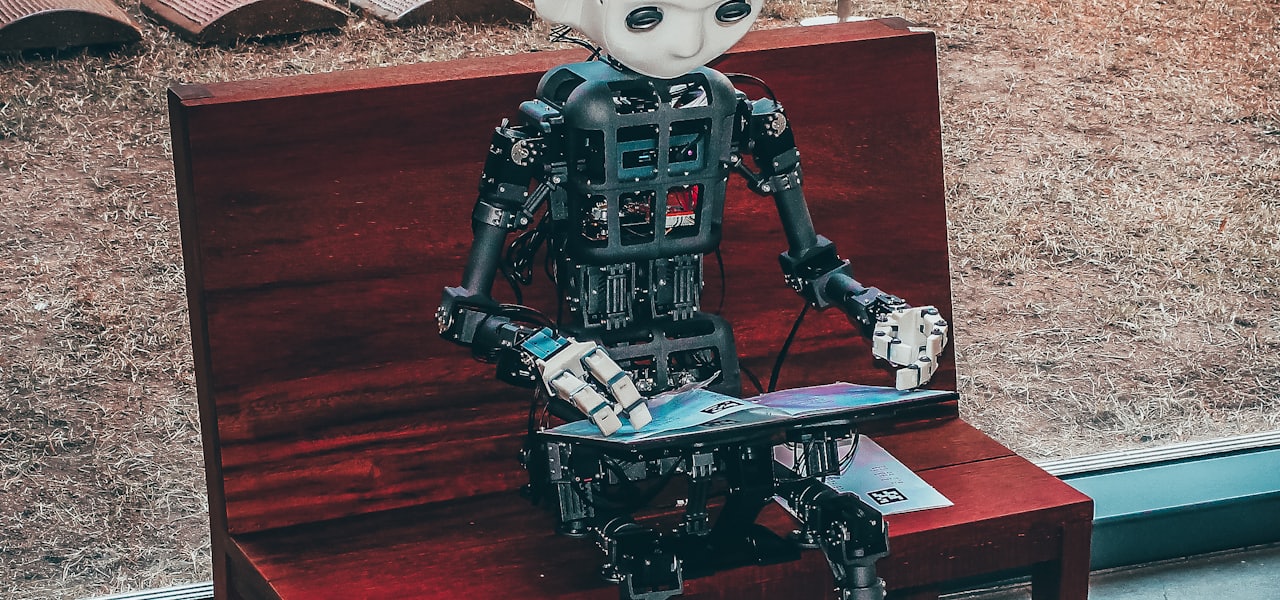
    Augmented Analytics is an approach of data analytics that employs the use of machine learning and natural language processing to automate analysis processes normally done by a specialist or data scientist. The term was introduced in 2017 by Rita Sallam, Cindi Howson, and Carlie Idoine in a Gartner research paper. Augmented analytics is based on business intelligence and analytics. In the graph extraction step, data from different sources are investigated. == Defining Augmented Analytics == Machine Learning – a systematic computing method that uses algorithms to sift through data to identify relationships, trends, and patterns. It is a process that allows algorithms to dynamically learn from data instead of having a set base of programmed rules. Natural language generation (NLG) – a software capability that takes unstructured data and translates it into plain-English, readable, language. Automating Insights – using machine learning algorithms to automate data analysis processes. Natural Language Query – enabling users to query data using business terms that are either typed onto a search box or spoken. == Data Democratization == Data Democratization is the democratizing data access in order to relieve data congestion and get rid of any sense of data "gatekeepers". This process must be implemented alongside a method for users to make sense of the data. This process is used in hopes of speeding up company decision making and uncovering opportunities hidden in data. There are three aspects to democratising data: Data Parameterisation and Characterisation. Data Decentralisation using an OS of blockchain and DLT technologies, as well as an independently governed secure data exchange to enable trust. Consent Market-driven Data Monetisation. When it comes to connecting assets, there are two features that will accelerate the adoption and usage of data democratisation: decentralized identity management and business data object monetization of data ownership. It enables multiple individuals and organizations to identify, authenticate, and authorize participants and organizations, enabling them to access services, data or systems across multiple networks, organizations, environments, and use cases. It empowers users and enables a personalized, self-service digital onboarding system so that users can self-authenticate without relying on a central administration function to process their information. Simultaneously, decentralized identity management ensures the user is authorized to perform actions subject to the system’s policies based on their attributes (role, department, organization, etc.) and/ or physical location. == Use cases == Agriculture – Farmers collect data on water use, soil temperature, moisture content and crop growth, augmented analytics can be used to make sense of this data and possibly identify insights that the user can then use to make business decisions. Smart Cities – Many cities across the United States, known as Smart Cities collect large amounts of data on a daily basis. Augmented analytics can be used to simplify this data in order to increase effectiveness in city management (transportation, natural disasters, etc.). Analytic Dashboards – Augmented analytics has the ability to take large data sets and create highly interactive and informative analytical dashboards that assist in many organizational decisions. Augmented Data Discovery – Using an augmented analytics process can assist organizations in automatically finding, visualizing and narrating potentially important data correlations and trends. Data Preparation – Augmented analytics platforms have the ability to take large amounts of data and organize and "clean" the data in order for it to be usable for future analyses. Business – Businesses collect large amounts of data, daily. Some examples of types of data collected in business operations include; sales data, consumer behavior data, distribution data. An augmented analytics platform provides access to analysis of this data, which could be used in making business decisions.

    Read more →
  • Xiaomi MiMo

    Xiaomi MiMo

    Xiaomi MiMo is a family of large language models (LLMs) developed by Xiaomi. It was initially released in April 2025 with the MiMo-7B model. Currently, MiMo is available for developers through API service. It is used as the key AI model in Xiaomi's "Human x Car x Home" ecosystem. == Development == Xiaomi developed MiMo as a reasoning-focused language model. Its development team was led by Luo Fuli, who had previously worked at DeepSeek before joining Xiaomi in late 2025. The model was trained using multi-token prediction and reinforcement learning, with a particular emphasis on mathematical reasoning and code generation tasks. In March 2026, Xiaomi CEO Lei Jun announced that the company planned to invest at least US$8.7 billion in artificial intelligence over the following three years. == Models == === List of models === === MiMo-7B === MiMo-7B is the first model of this LLM. The base model, MiMo-7B-Base, was pre-trained on approximately 25 trillion tokens using web pages, academic papers, books, and synthetic reasoning data. MiMo-7B-RL underwent supervised fine-tuning and reinforcement learning on 130,000 mathematics and code problems. MiMo-7B-RL-0530 was released in May 2025. It scaled the fine-tuning dataset from 500,000 to 6 million instances and extended the RL window from 32,000 to 48,000 tokens and improved AIME 2024 scores from 68.2 to 80.1. MiMo-VL-7B was a vision-language model combining a Vision Transformer encoder with the MiMo-7B backbone. It was trained in four stages consuming 2.4 trillion tokens. Its reinforcement learning variant used Mixed On-Policy Reinforcement Learning (MORL) which integrated reward signals across perception, grounding, and reasoning. Xiaomi also released MiMo-Audio-7B, an audio-language model for voice conversion, style transfer, and speech editing. === MiMo-V2-Flash === MiMo-V2-Flash was launched in December 2025. It is a open-sourced Mixture-of-experts model with 309 billion total parameters and 15 billion active parameters. It was trained on 27 trillion tokens using FP8 mixed precision. It used hybrid attention interleaving Sliding Window and Global Attention at a 5:1 ratio. === MiMo-V2-Pro === Xiaomi publicly introduced MiMo-V2-Pro on 18 March 2026. It has over 1 trillion total parameters, 42 billion active, and a 1-million-token context window. Before the official release, the model had appeared anonymously on OpenRouter under the codename "Hunter Alpha," where it drew substantial usage and topped daily charts for several days, according to Xiaomi and Reuters. During its listing on OpenRouter, the model reportedly processed over one trillion tokens in total usage. Xiaomi later said Hunter Alpha was an early internal test build of MiMo-V2-Pro, and Reuters reported that the model had been mistaken by some users for a possible DeepSeek system before Xiaomi confirmed its origin. The model was released as a proprietary API product, and Luo Fuli stated that Xiaomi intended to open-source a variant at an unspecified future date. Xiaomi has partnered with several API web platforms like OpenClaw to launch the model. All these websites initially offered a free trial of this model for a week, but due to the overwhelming response, Xiaomi later extended the free trial period of the model until 2 April 2026. === MiMo-V2-Omni === Alongside MiMo-V2-Pro, Xiaomi launched MiMo-V2-Omni on 18 March 2026. It handles image, video, audio, and text inputs. Before the official release, it was codenamed "Healer Alpha" in OpenRouter. === MiMo-V2-TTS === On the same date as the release of MiMo-V2-Pro and MiMo-V2-Omni, a Text-to-Speech model named MiMo-V2-TTS was released also. It is a speech synthesis model. It was trained on audio data, which makes it capable of emotional transitions, mid-sentence tone shifts, singing, and synthesis of regional dialects like Sichuan, Cantonese, Henan, and Taiwanese. == Licensing == Xiaomi has used different licensing approaches for different models in the MiMo family. The MiMo-7B series and MiMo-V2-Flash were released as open-weight models. MiMo-V2-Flash was published under the MIT license with model weights and inference code available on Hugging Face. MiMo-V2-Pro and MiMo-V2-Omni were released as proprietary models. It was accessible through Xiaomi's API platform and third-party API providers. Luo Fuli stated that Xiaomi intended to open-source a variant of MiMo-V2-Pro. Although, she did not specify any timeline. MiMo-V2-TTS was released as a proprietary model with no publicly available weights.

    Read more →
  • Control-flow integrity

    Control-flow integrity

    Control-flow integrity (CFI) is a general term for computer security techniques that prevent a wide variety of malware attacks from redirecting the flow of execution (the control flow) of a program. == Background == A computer program commonly changes its control flow to make decisions and use different parts of the code. Such transfers may be direct, in that the target address is written in the code itself, or indirect, in that the target address itself is a variable in memory or a CPU register. In a typical function call, the program performs a direct call, but returns to the caller function using the stack – an indirect backward-edge transfer. When a function pointer is called, such as from a virtual table, we say there is an indirect forward-edge transfer. Attackers seek to inject code into a program to make use of its privileges or to extract data from its memory space. Before executable code was commonly made read-only, an attacker could arbitrarily change the code as it is run, targeting direct transfers or even do with no transfers at all. After W^X became widespread, an attacker wants to instead redirect execution to a separate, unprotected area containing the code to be run, making use of indirect transfers: one could overwrite the virtual table for a forward-edge attack or change the call stack for a backward-edge attack (return-oriented programming). CFI is designed to protect indirect transfers from going to unintended locations. == Techniques == Associated techniques include code-pointer separation (CPS), code-pointer integrity (CPI), stack canaries, shadow stacks (SS), and vtable pointer verification. These protections can be classified into either coarse-grained or fine-grained based on the number of targets restricted. A coarse-grained forward-edge CFI implementation, could, for example, restrict the set of indirect call targets to any function that may be indirectly called in the program, while a fine-grained one would restrict each indirect call site to functions that have the same type as the function to be called. Similarly, for a backward edge scheme protecting returns, a coarse-grained implementation would only allow the procedure to return to a function of the same type (of which there could be many, especially for common prototypes), while a fine-grained one would enforce precise return matching (so it can return only to the function that called it). == Implementations == Related implementations are available in Clang (LLVM front-end),, GNU Compiler Collection, Microsoft's Control Flow Guard and Return Flow Guard, Google's Indirect Function-Call Checks and Reuse Attack Protector (RAP). === LLVM/Clang === The LLVM compiler's C/C++ front-end Clang provides a number of "CFI" schemes that works on the forward edge by checking for errors in virtual tables and type casts. Not all of the schemes are supported on all platforms and most of them, the exception being two "kcfi" schemes intended for low-level kernel software, depends on link-time optimization (LTO) to know what functions are supposed to be called in normal cases. Also provided is a separate "shadow call stack" (SCS) instrumentation pass that defends on the backward edge by checking for call stack modifications, available only for the aarch64 and RISC-V ISAs. And due to use of a shared processor register SCS is only enforceable on certain ABIs or if in other ways it is ensured that any other software using the register set (thread/processor) does not interfere with this use. Google has shipped Android with the Linux kernel compiled by Clang with link-time optimization (LTO) and CFI enabled since 2018. Even though SCS is available for the Linux kernel as an option, and support is also available for Android's system components it is recommended only to enable it for components for which it can be ensured that no third party code is loaded. === GCC === The GNU Compiler Collection implemented a "shadow call stack" compatible with Clang for aarch64 in v12 released in 2022. This feature is primarily intended for building the Linux kernel as support is missing from GCC user space libraries. === Intel Control-flow Enforcement Technology === Intel Control-flow Enforcement Technology (CET) detects compromises to control flow integrity with a shadow stack (SS) and indirect branch tracking (IBT). The kernel must map a region of memory for the shadow stack not writable to user space programs except by special instructions. The shadow stack stores a copy of the return address of each CALL. On a RET, the processor checks if the return address stored in the normal stack and shadow stack are equal. If the addresses are not equal, the processor generates an INT #21 (Control Flow Protection Fault). Indirect branch tracking detects indirect JMP or CALL instructions to unauthorized targets. It is implemented by adding a new internal state machine in the processor. The behavior of indirect JMP and CALL instructions is changed so that they switch the state machine from IDLE to WAIT_FOR_ENDBRANCH. In the WAIT_FOR_ENDBRANCH state, the next instruction to be executed is required to be the new ENDBRANCH instruction (ENDBR32 in 32-bit mode or ENDBR64 in 64-bit mode), which changes the internal state machine from WAIT_FOR_ENDBRANCH back to IDLE. Thus every authorized target of an indirect JMP or CALL must begin with ENDBRANCH. If the processor is in a WAIT_FOR_ENDBRANCH state (meaning, the previous instruction was an indirect JMP or CALL), and the next instruction is not an ENDBRANCH instruction, the processor generates an INT #21 (Control Flow Protection Fault). On processors not supporting CET indirect branch tracking, ENDBRANCH instructions are interpreted as NOPs and have no effect. === Microsoft Control Flow Guard === Control Flow Guard (CFG) was first released for Windows 8.1 Update 3 (KB3000850) in November 2014. Developers can add CFG to their programs by adding the /guard:cf linker flag before program linking in Visual Studio 2015 or newer. As of Windows 10 Creators Update (Windows 10 version 1703), the Windows kernel is compiled with CFG. The Windows kernel uses Hyper-V to prevent malicious kernel code from overwriting the CFG bitmap. CFG operates by creating a per-process bitmap, where a set bit indicates that the address is a valid destination. Before performing each indirect function call, the application checks if the destination address is in the bitmap. If the destination address is not in the bitmap, the program terminates. This makes it more difficult for an attacker to exploit a use-after-free by replacing an object's contents and then using an indirect function call to execute a payload. ==== Implementation details ==== For all protected indirect function calls, the _guard_check_icall function is called, which performs the following steps: Convert the target address to an offset and bit number in the bitmap. The highest 3 bytes are the byte offset in the bitmap The bit offset is a 5-bit value. The first four bits are the 4th through 8th low-order bits of the address. The 5th bit of the bit offset is set to 0 if the destination address is aligned with 0x10 (last four bits are 0), and 1 if it is not. Examine the target's address value in the bitmap If the target address is in the bitmap, return without an error. If the target address is not in the bitmap, terminate the program. ==== Bypass techniques ==== There are several generic techniques for bypassing CFG: Set the destination to code located in a non-CFG module loaded in the same process. Find an indirect call that was not protected by CFG (either CALL or JMP). Use a function call with a different number of arguments than the call is designed for, causing a stack misalignment, and code execution after the function returns (patched in Windows 10). Use a function call with the same number of arguments, but one of pointers passed is treated as an object and writes to a pointer-based offset, allowing overwriting a return address. Overwrite the function call used by the CFG to validate the address (patched in March 2015) Set the CFG bitmap to all 1's, allowing all indirect function calls Use a controlled-write primitive to overwrite an address on the stack (since the stack is not protected by CFG) === Microsoft eXtended Flow Guard === eXtended Flow Guard (XFG) has not been officially released yet, but is available in the Windows Insider preview and was publicly presented at Bluehat Shanghai in 2019. XFG extends CFG by validating function call signatures to ensure that indirect function calls are only to the subset of functions with the same signature. Function call signature validation is implemented by adding instructions to store the target function's hash in register r10 immediately prior to the indirect call and storing the calculated function hash in the memory immediately preceding the target address's code. When the indirect call is made, the XFG validation function compares the value in r10 to the target

    Read more →
  • Integreat

    Integreat

    Integreat (former project name: Refguide+) is an open source mobile app that provides local information and services tailored to refugees and migrants coming to Germany. The content is maintained by local organizations, such as local governments or integration officers, and made available in locally relevant languages. It was developed by Tür an Tür - Digitalfabrik gGmbH (formerly Tür an Tür - Digital Factory gGmbH) in Augsburg together with a team of researchers and students from the Technical University of Munich. == History == In 1997, the Augsburg association "Tür an Tür", which has been working for refugees since 1992, published the brochure "First Steps", which answers local everyday questions. Since addresses and contact persons change quickly, some information is already outdated after a few weeks. Students of business informatics at the Technical University of Munich therefore developed the app Integreat within eight months together with the association and the social department of the city of Augsburg. The app was then also used by other cities and districts within months. As of February 3, 2022, information is available at 72 locations, including Munich, Dortmund, Nuremberg and Augsburg. == Mode of action == Refugees need information on areas such as registration, contact persons, health care, education, family, work and everyday life. Integreat seeks to provide refugees with this information by allowing them to select their geographic location and receive locally relevant information. This information is available offline once the app is opened so it can be used without an internet connection. In addition, the content is translated into the native languages of refugees and migrants to facilitate access. The content is licensed with a CC BY 4.0 license to facilitate collaboration and translation between content creators and dissemination of the content. Integreat is now being used for a broader migrant audience and says it can also support professionals, volunteers, and counseling centers. == Comparable mobile apps == Other mobile apps that are likewise intended to provide initial orientation for refugees include the app Ankommen, a joint project of the Federal Office for Migration and Refugees, the Goethe-Institut, the Federal Employment Agency and the Bavarian Broadcasting Corporation, which is intended as a companion for the first few weeks in Germany, and the Welcome App, a company-sponsored non-profit initiative for information about Germany and asylum procedures with a regional focus, and a book by the Konrad Adenauer Foundation (KAS) and Verlag Herder with a corresponding app Deutschland - Erste Informationen für Flüchtlinge (Germany - First Information for Refugees) as a companion for Arabic-speaking refugees in Germany.

    Read more →
  • AdTruth

    AdTruth

    AdTruth is a software product and the digital media division of 41st Parameter, a company headquartered in Scottsdale, Arizona, with regional offices in San Jose, California; London, England; and Munich, Germany. AdTruth allows marketers to recognize and reach target audiences across online devices. AdTruth software identifies users for targeting, tracking, performance tracking across digital media, including mobile and desktop, by analysing patterns in large numbers of advertisements served over the internet, rather than through the use of cookies. == History == AdTruth was founded in 2011 by Ori Eisen of 41st Parameter, to repurpose the company's fraud detection and prevention technology, for use within the advertising industry to accurately target intended audiences, particularly in mobile. Eisen was joined by James Lamberti in the role of vice president and general manager. In 2012 41st Parameter raised $13 million in Series D financing from Norwest Venture Partners, Kleiner Perkins Caufield & Byers, Jafco Ventures and Georgian Partners, bringing total funding to about $35 million. In May 2012, AdTruth hosted a meeting of digital media executives to discuss Apple’s UDID deprecation, with the intent of developing a device-neutral replacement standard. AdTruth joined the World Wide Web Consortium's Tracking Protection Working Group, which provides guidance for implementing and adhering to Do Not Track policies. AdTruth also worked with privacy firm Truste to create a privacy compliant Do Not Track-style mechanism for mobile. In 2013, the company Experian purchased 41st Parameter, acquiring AdTruth as part of the deal. == Product == AdTruth software helps marketers track, target and retarget consumers using more than 100 parameters, including milliseconds in differences in the internal clock setting, to recognize a particular device anonymously. AdTruth's technology uses non-UDID information to identify a wide range of devices for cookieless ad targeting. Its technology currently has about a 90 percent accuracy rate on iOS, higher on Android and desktop. AdTruth also has mobile web to app bridging capabilities as well as DeviceInsight technology, enabling marketers to identify users across mobile web and app content. 41st Parameter's patented AdTruth technology is being used by MdotM, in response to the deprecation of the UDID that included tracking and targeting capabilities. == Competitors == AdTruth's main competitor is BlueCava, which deploys a similar device-fingerprinting technology.

    Read more →